
Why the ACCESS Model Needs Standardized Wearable Data
Many companies working with the ACCESS model will face the same challenge:
Patients use different devices.
Those devices generate inconsistent data.
And inconsistent data makes reporting, analysis, and decision-making more complicated.
This may seem like a technical issue at first, but it can quickly become a major obstacle when trying to scale patient monitoring, measure outcomes, and demonstrate value.
The Challenge: Different Devices, Different Data
In an ACCESS model, companies often need to understand what is happening with patients outside traditional clinical environments. Wearables and connected health devices can provide valuable information about activity, sleep, recovery, heart rate, glucose, blood pressure, and other health signals.
The problem is that patients do not all use the same device.
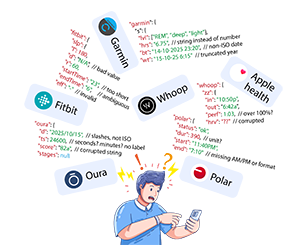
Some may use Apple Health, Fitbit, Garmin, Oura, Samsung Health, Health Connect, Dexcom, or other platforms. Each one structures data differently, measures certain metrics in its own way, and provides different levels of detail.
As a result, companies may receive health data that is fragmented, inconsistent, and difficult to compare across patients.
Why This Matters for Reporting
The ACCESS model depends on clear and reliable reporting. Companies need to show patient engagement, health trends, intervention impact, adherence, and outcomes over time.
But when the data comes from multiple devices in different formats, teams must spend extra time cleaning, mapping, validating, and normalizing the information before it can be used.
This creates friction in areas such as:
Patient progress tracking
Outcome measurement
Clinical or operational reports
Program performance analysis
Evidence generation
Stakeholder reporting
Without standardized data, it becomes harder to answer important questions: Is the program working? Are patients improving? Are they engaging consistently? Which data points can be trusted?
The Obstacle Is Bigger Than Expected
At small scale, this problem may seem manageable. Teams can manually review data, adjust reports, or build custom mappings for specific devices.
But as more patients join the program, the complexity grows quickly.
More patients means more devices, more formats, more edge cases, and more reporting requirements. What starts as a data integration task can become a major operational bottleneck.
For companies using the ACCESS model, this can slow down adoption, limit scalability, and make it harder to prove impact.

The Role of Standardized Wearable Data
To make the ACCESS model scalable, companies need a consistent data infrastructure that can unify health data across different devices and platforms.
That means being able to:
Connect to multiple wearable and health data sources
Normalize data into a common structure
Reduce manual data cleaning
Improve reporting consistency
Support better patient insights
Enable more reliable evidence generation
With standardized wearable data, companies can move from fragmented information to usable insights.

How ROOK Helps Solve This Problem
This is where ROOK can become a key layer for companies working with the ACCESS model.
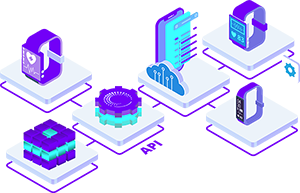
ROOK makes it possible to unify health data from multiple wearables, devices, and platforms through a single API. Instead of each company having to build individual integrations, map different formats, and maintain multiple connections, ROOK delivers structured, normalized, and ready-to-use data.
This helps companies:
Reduce the technical complexity of integrating multiple devices.
Standardize health data from different sources.
Improve reporting consistency.
Make patient progress tracking easier.
Generate more reliable insights into behavior, adherence, and outcomes.
Scale programs without relying on manual data cleaning and normalization processes.
For teams using the ACCESS model, ROOK can act as a data infrastructure layer that turns scattered signals into clear, comparable, and actionable information.
Final Thought
The ACCESS model has the potential to make healthcare more continuous, personalized, and data-driven. But for that potential to be realized, the data layer must be reliable.
Patients will continue using different devices.
Data will continue arriving in different formats.
Reporting will become more difficult without standardization.
That is why wearable data infrastructure will be critical for companies building around the ACCESS model.
The future will not depend only on collecting more data, but on making that data clean, consistent, and actionable.
Ready to take your wearable data integration to the next level?
Schedule a call with us today to learn how ROOK can help simplify integrations and accelerate your product development. Here
Learn More: