
What the Validic and Spike Acquisitions Mean for Health Data API Buyers — and Why ROOK Is the Independent Alternative
The health data infrastructure market is consolidating. For companies building on wearable and health data, now is the right time to evaluate your options.
The market is changing
Two major developments have changed the health data infrastructure landscape in 2026. ChartSpan completed its acquisition of Validic, bringing Validic’s health data infrastructure together with ChartSpan’s clinical services, remote patient monitoring, and care management business.
Raintree acquired Spike Technologies, bringing Spike’s technology into Raintree’s broader platform strategy for rehabilitation and physical therapy organizations.
Neither acquisition automatically means that existing customers need to migrate today. But acquisitions inevitably raise an important question for product and engineering teams:
What happens when the strategic priorities of your data infrastructure provider change?
For companies whose products depend on reliable access to wearable and health data, that question matters. It is also one reason more teams are evaluating ROOK as an independent alternative to Validic and Spike.
What does the Validic acquisition mean for customers?
Validic has been one of the established companies in connected health data. Its platform has historically focused heavily on healthcare organizations, remote patient monitoring, EHR integration, and personal health data infrastructure.
With ChartSpan now owning Validic, the combined business can bring together clinical services, remote patient monitoring, care management, device logistics, and health data infrastructure. That may be compelling for organizations looking for an end-to-end clinical care platform, but many product teams have a different requirement.
They do not need a clinical services ecosystem. They need reliable health data infrastructure that they can embed into their own product.
That distinction matters. If your product is a consumer fitness app, digital health platform, insurance product, wellness application, or AI health application, you may simply need reliable access to the health data your users already generate.
What does the Spike acquisition mean?
Spike took a somewhat different path. Its platform has focused on connecting health data sources and making that information accessible to developers and digital health companies.
Raintree’s acquisition gives Spike a new strategic home inside a company focused on rehabilitation and physical therapy software. Again, an acquisition does not necessarily mean that an API disappears, but it does change the strategic context for companies that depend on that infrastructure.
For developers evaluating a health data infrastructure partner, an important question becomes:
Is health data infrastructure the core business—or one component of a broader platform strategy?
Why vendor independence matters
When you build your product around a health data API, you are not just choosing a technology vendor. You are choosing part of your infrastructure.
Your users authorize their Apple Health, Garmin, Oura, Fitbit, WHOOP, and other accounts through that infrastructure. Your backend depends on its schemas, your application logic depends on its data models, your analytics depend on its normalization, and your product roadmap depends on its integrations.
Migrating later is not simply a matter of changing one API endpoint. That is why we believe independence matters.
ROOK’s sole focus is health data infrastructure. We do not operate an EHR, run a clinical services business, operate a physical therapy platform, or sell remote patient monitoring programs. We build infrastructure for companies that want to build those products themselves.
ROOK: Built for teams that need health data infrastructure
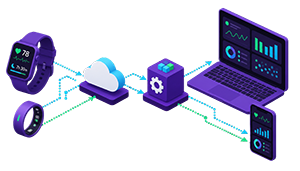
ROOK provides unified API and SDK infrastructure for connecting applications to 500+ health data sources, wearables, and health apps. Instead of integrating every provider independently, you integrate ROOK once.
The platform is designed around the needs of digital health, fitness, wellness, insurance, and other companies that need consistent access to health data without building and maintaining hundreds of integrations themselves.
1. 500+ integrations through one API
ROOK supports 500+ integrations across wearable devices, health platforms, mobile health ecosystems, and other data sources. That includes major ecosystems such as Apple Health, Health Connect, Garmin, Fitbit, Oura, WHOOP, Samsung Health, Polar, Withings, Dexcom, Strava, Xiaomi, Zepp, and more.
This means your engineering team does not need to maintain a separate integration for every wearable or health platform.
2. Normalized, structured health data
Different devices measure and represent health data differently. ROOK normalizes those differences into consistent data models so your application can work with health data without building provider-specific transformation layers.
The result is clean, comparable, structured health data that your team can use across products, analytics, AI workflows, and user experiences.
3. API + SDK infrastructure
Not every health data source works the same way. Some require API-based integrations, while others require mobile SDKs.
ROOK supports both approaches, allowing teams to connect users to data sources through the architecture that makes sense for each platform. ROOK’s SDKs support mobile health ecosystems such as Apple Health and Health Connect, while API integrations support providers such as Garmin, WHOOP, Oura, Fitbit, Withings, and others.
4. Real-time delivery through webhooks
Health data is not particularly useful if your application constantly has to poll for updates. ROOK supports webhook-based delivery for new health data, with API access available for on-demand queries.
This gives engineering teams a consistent way to receive normalized health data while reducing the operational complexity of managing provider-specific update mechanisms.
5. Built for developers
ROOK provides a sandbox environment, API documentation, SDKs, developer tooling, and implementation support designed to get teams from integration to production quickly.
The goal is simple: your engineers should build your product, not spend their time maintaining wearable integrations.
ROOK vs. building it yourself
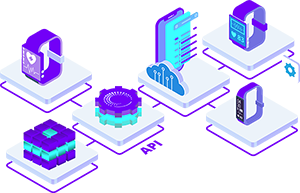
The alternative to Validic or Spike is not necessarily another API. It is often an internal engineering project.
At first, building one integration looks straightforward. Then you need another, followed by another. Apple changes something, a wearable changes its permissions, a provider introduces a new API version, or a data field means something slightly different across platforms. A webhook may fail, historical data may behave differently, or a user may disconnect and reconnect their account.
Suddenly, your team is not building your product anymore. They are operating a health data infrastructure company inside your health product.
ROOK exists to take that burden away. Our platform provides one integration layer across 500+ health data sources, with normalization and ongoing integration maintenance handled by ROOK.
If you’re evaluating a Validic or Spike alternative
You do not need to make a rushed decision. But if your current health data infrastructure provider has recently been acquired—or if you are evaluating providers for a new product—now is a good time to ask a few additional questions.
Ask about strategic focus
Is health data infrastructure the company’s primary business?
Or is it becoming one component of a larger platform?
Ask about roadmap control
Who decides which integrations get built?
How are provider API changes prioritized?
What happens when your use case is not aligned with the parent company’s strategy?
Ask about migration
How difficult would it be to move your users and data connections if you ever needed to?
Can the provider support a phased migration?
How closely do its data models match your existing architecture?
Ask about developer experience
How quickly can your team go from sandbox to production?
How good is the documentation?
Do you have access to implementation support?
Can your engineers test integrations before committing to a long-term contract?
Ask about scalability
Can the platform support your product as you move from hundreds of users to thousands, hundreds of thousands, or millions?
And can it continue adding new data sources without requiring significant engineering work from your team?
A more independent path forward
The acquisitions of Validic and Spike are not necessarily bad news for their customers. In many cases, acquisitions can bring additional resources, capital, distribution, and capabilities.
But they are a reminder of something every technology buyer should consider:
Your infrastructure provider’s strategy eventually becomes part of your product’s strategy.
If your company depends on wearable and health data, you want a partner whose incentives are aligned with yours: a partner whose job is to make health data infrastructure better through more integrations, better normalization, more reliable delivery, better developer tooling, more data, faster implementation, and less infrastructure for your team to maintain.
That’s what we’re building atROOK.
If you’re currently using Validic or Spike and evaluating your options, we’d be happy to help you assess what a migration to ROOK would look like, including integration coverage, data models, architecture, and migration requirements.
Explore ROOK’s supported data sources andAPI documentation, or start testing in oursandbox.
One integration. 500+ health data sources. Built specifically for teams building the future of health.