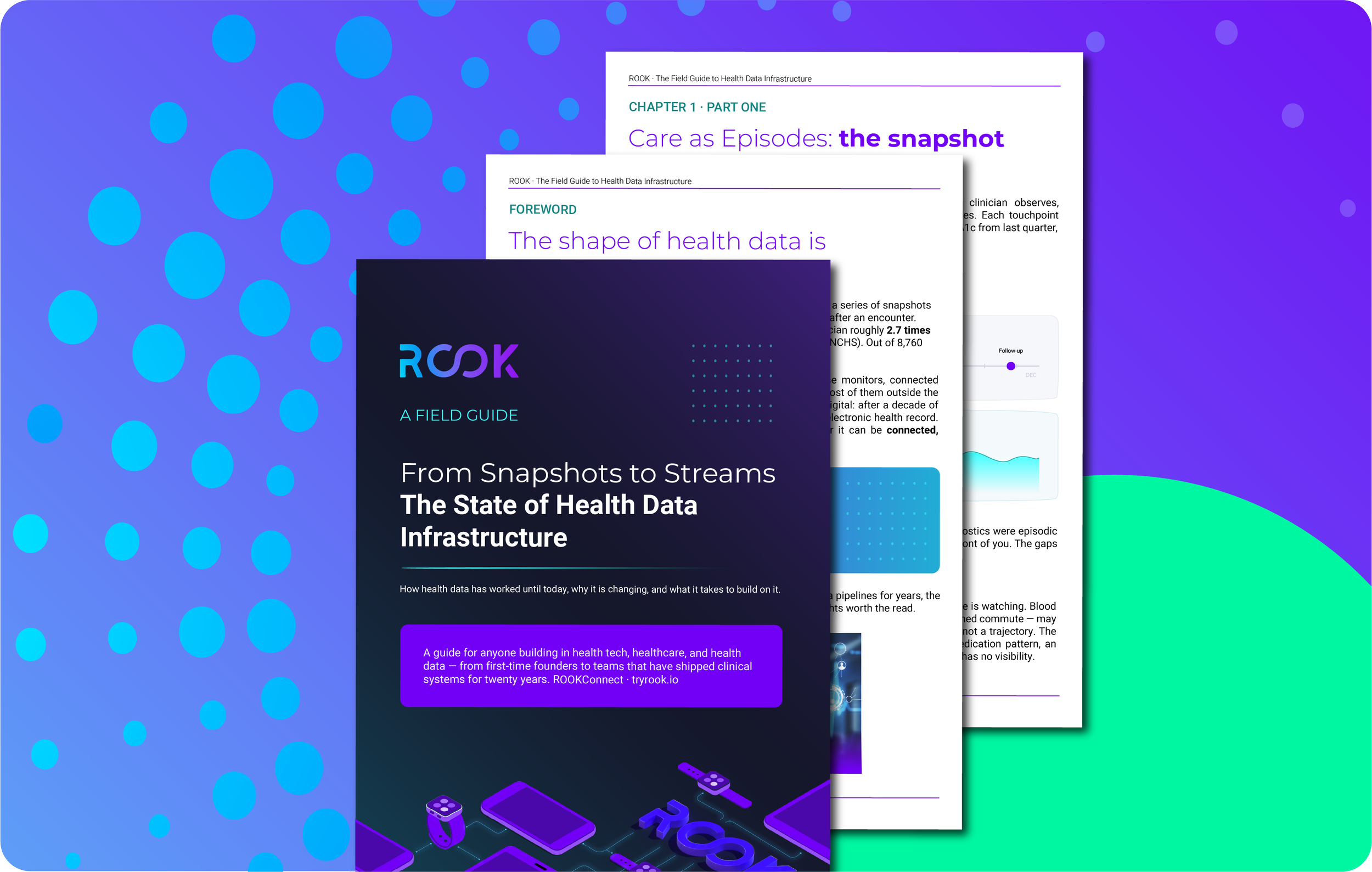
From Snapshots to Streams: key insights from the guide
Ebook description:
Health data infrastructure — the gap between what's possible and what's built
Wearables, continuous glucose monitors, and home labs now generate health signals around the clock—yet most of that data never reaches the people who could use it. Despite a decade of digitization, the system still can't connect, standardize, and act on the information it has.
Our latest guide, "From Snapshots to Streams," examines how health data has worked until today, why that model is breaking down, and what it takes to build infrastructure that keeps pace with continuous, multi-source data.
The state of health data: key insights
Digitization solved one problem and exposed another: 96% of U.S. hospitals run a certified EHR, but only 43% routinely integrate outside data. The records went digital—they didn't become liquid.
The reach gap is striking: 78% of wearable users are willing to share their data with a clinician, but only 27% have. The signal exists; the infrastructure to deliver it reliably doesn't.
Building that infrastructure in-house is costly too. Point-to-point integrations scale as sources × destinations, and a single one can cost $150,000–$400,000 per year to maintain.
AI and change-detection layers are already closing this gap—turning fragmented streams into actionable signal, often before complications arise.
About this report
The guide examines the historical "snapshot" model of health data, the four cracks left by digitization (silos, inconsistent definitions, the integration tax, and the snapshot blind spot), and the new complexity of continuous data: normalization, consent, regulation, and data availability as a clinical signal. It also explores how a standardized infrastructure layer like ROOKConnect closes the reach gap across digital health, RPM, clinical research, and pharma.
Download our ebook