
Breaking Down the 150+ Companies Accepted into CMS's ACCESS Model
CMS published the list of accepted applicants for the ACCESS model — a program designed to advance value-based care across four clinical areas: enhanced Chronic Kidney and Metabolic (eCKM), Chronic Kidney and Metabolic (CKM), Behavioral Health, and Musculoskeletal Health.
The list has 187 accepted entities. We segmented them, ran the numbers, and identified the patterns that matter for anyone building in this space.
How We Read the List
CMS counts each legal entity separately. That means state-specific subsidiaries and affiliated medical groups may appear as individual entries even if they share a parent organization. Companies like Cadence Health, Pair Team, Devoted Medical, Mederva, and Story Health each appear as a single entry.
The 187 figure represents applicant entities, not necessarily 187 distinct parent companies. Because organizations can participate in multiple tracks, percentages overlap and do not sum to 100%.
Track Participation at a Glance
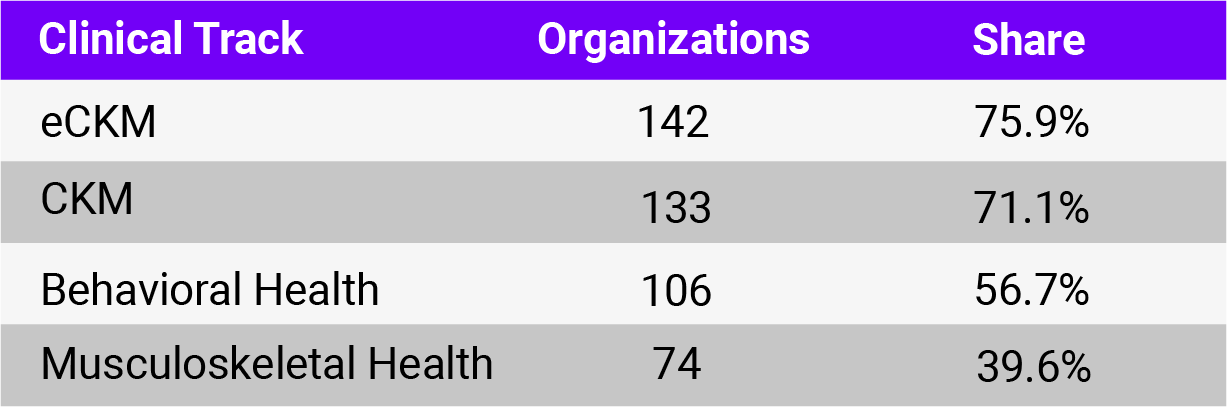
eCKM leads with the broadest participation, followed closely by CKM. Behavioral Health appears in more than half of all entries. MSK has the lowest total count, but the vast majority of MSK organizations pair it with at least one other track.
Most Organizations Are Participating in Multiple Tracks
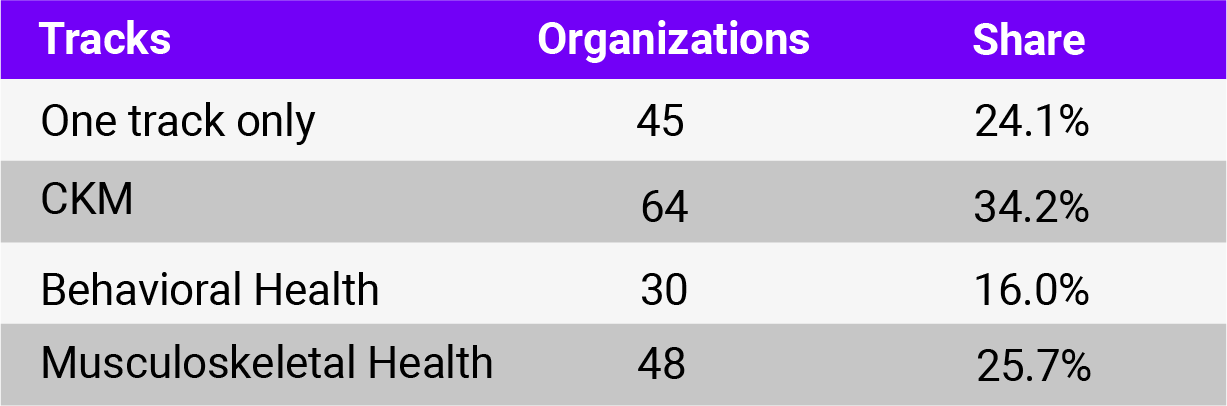
142 organizations — 75.9% of the list — are participating in two or more tracks. This signals that the organizations entering ACCESS are not thinking about chronic conditions, behavioral health, and physical function as isolated silos. They're building for the whole person.
Segment 1: eCKM + CKM Core
eCKM and CKM form the backbone of the ACCESS ecosystem. Of the 187 entries, 127 participate in both — 67.9% of the full list. The most common single combination is eCKM + CKM alone: 50 organizations (26.7%).
This segment includes organizations focused on:
• Primary care and care management
• Cardiology and nephrology
• Diabetes and metabolic health
• Remote monitoring
• Chronic condition management platforms
The strong overlap between eCKM and CKM suggests these organizations see early intervention and ongoing condition management as part of the same care pathway.
Segment 2: Full-Spectrum Organizations
48 organizations — 25.7% of the list — are participating in all four tracks. This is the second most common combination overall. Examples include CareHarmony, Castlight, GenieMD, PocketRN, SynsorMed, and VirtualCare Medical Group.
These organizations are positioned to support patients across multiple health dimensions simultaneously: chronic condition management, behavioral and mental health, physical function, and habit change. Organizations participating across all four tracks need to integrate clinical, behavioral, biometric, activity, and engagement data into a single coherent experience.
Segment 3: Behavioral Health
Behavioral Health appears in 106 entries — 56.7% of the list. 20 organizations focus exclusively on Behavioral Health, including Headspace, SonderMind, Innerwell, Mindoula Health, Concert Health, and Sleep Reset.
But the more significant pattern is integration, not specialization. Of the 106 Behavioral Health organizations, 86 also participate in at least one physical health track — 81.1% of the segment. 25 organizations combine eCKM, CKM, and Behavioral Health; another 48 include Behavioral Health as part of a four-track model.
This reflects a growing clinical consensus: stress, mental health, motivation, adherence, and behavior are not separate from chronic disease management. They're embedded in it.
Segment 4: Musculoskeletal and Mobility
MSK appears in 74 entries (39.6%). Only 10 organizations participate exclusively in MSK — examples include Bold, Flagler Health, JOGO Health, Livara Health, Plethy, and TailorCare Provider Services.
The remaining 64 MSK organizations — 86.5% — participate in at least one additional track. This overlap reflects the real-world connection between mobility, pain, physical activity, emotional wellbeing, and chronic condition management.
Segment 5: Single-Track Specialists
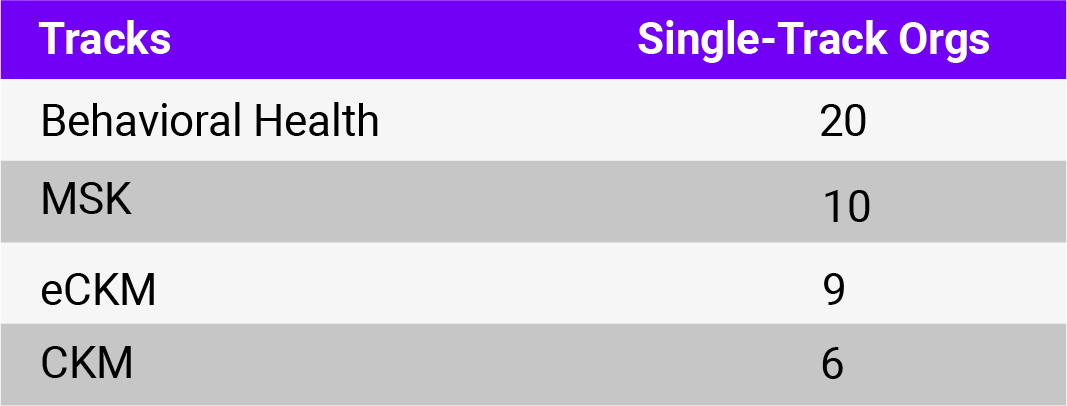
45 organizations (24.1%) participate in just one track. Single-track participation doesn't mean limited scope — it can reflect a focused clinical strategy, a specialized population, or a specific role within a broader care network.
Organizational Patterns Across the List
Regional and Specialty Medical Practices
Cardiology, nephrology, primary care, geriatrics, rehabilitation, and community health centers — such as Amelia Heart and Vascular Center, Renal Medicine Associates, and Mariposa Community Health Center.
Virtual and Technology-Enabled Care
Organizations like Avery Telehealth, Curai Health, Doctronic, PocketRN, and VirtualCare Medical Group depend on connected data to monitor changes between visits and coordinate care across distributed populations.
Consumer Health and Wellness Brands
Headspace, Noom, WeightWatchers, WHOOP Physician Services, and Withings Medical Group bring expertise in user engagement, behavior change, and continuous data collection.
Care Coordination and Infrastructure Platforms
CareHarmony, Castlight, Guidehealth, Verily Health, and Wellpoint Health Solutions connect patients, care teams, devices, and services across clinical tracks.
The Four Most Common Track Combinations
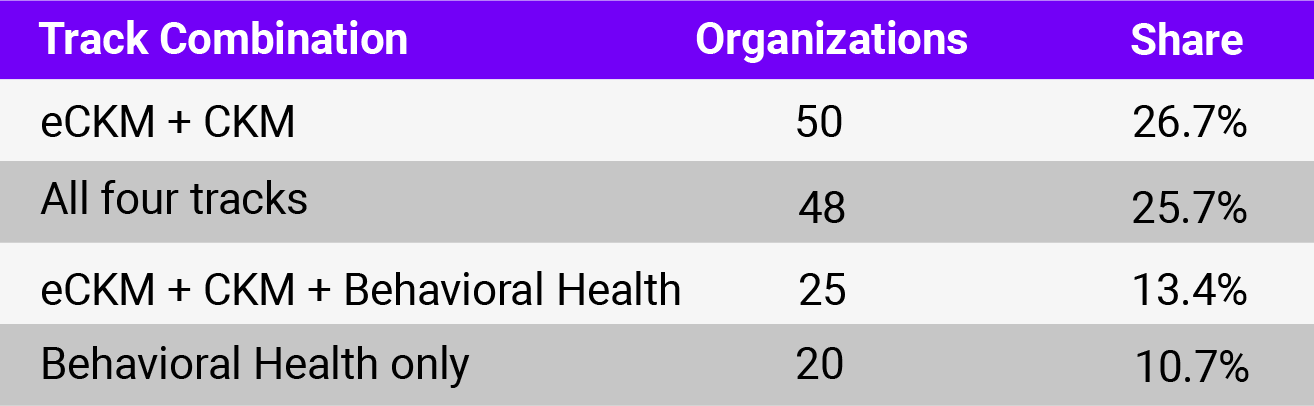
These four combinations account for 143 of the 187 entries — 76.5% of the full list. Three structural patterns emerge: eCKM and CKM are tightly coupled, behavioral health is increasingly integrated into broader chronic care models, and a substantial group is preparing to operate across all four tracks.
What This Means for Health Data
Multitrack care requires data from across a person's health experience. Depending on the population and
clinical model, organizations may need access to:
• Activity and exercise
• Heart rate and heart rate variability
• Sleep duration and quality
• Weight and body composition
• Blood pressure
• Blood glucose
• Oxygen saturation
• Recovery and stress markers
The challenge isn't just collecting more data. Organizations need to normalize it, surface meaningful signals, and deliver it in a format that care teams and applications can actually act on. Supporting multiple devices adds operational complexity — each source may use different permissions, formats, metric definitions, and sync processes. A unified health data infrastructure helps reduce that fragmentation so organizations can focus on care delivery rather than data plumbing.
Key Takeaways
• 187 applicant entities accepted across four clinical tracks
• eCKM leads with 142 organizations (75.9%)
• CKM follows with 133 (71.1%)
• Behavioral Health appears in 106 entries (56.7%)
• MSK appears in 74 entries (39.6%)
• 75.9% of organizations participate in two or more tracks
• 25.7% participate in all four tracks
• Behavioral Health and MSK are more commonly integrated than standalone
• The ecosystem spans traditional practices, digital health companies, consumer wellness brands, and care infrastructure platforms
The biggest pattern is convergence. Chronic care, behavioral health, mobility, remote monitoring, and consumer health technology are increasingly operating inside the same care models — and often within the same organization. For companies building these experiences, access to consistent, interoperable health data across devices and data types will be a foundational requirement.
Methodological note: This analysis is based on the ACCESS accepted applicants list published by CMS. Each legal entity was
counted separately. No external data on corporate ownership or parent-subsidiary relationships was added.
Source: CMS ACCESS Model Accepted Applicants —
https://www.cms.gov/priorities/innovation/access-model-accepted-applicants