
How to Turn Wearable Data Into a Scalable Reward System

Wearable data is no longer just about dashboards and step counts. The real opportunity is behavior design: turning health signals into motivation loops.
If you’re building a health app, insurance product, corporate wellness platform, or longevity program, wearable-driven rewards can:
Increase daily engagement
Improve retention
Drive measurable health outcomes
Create actuarial or underwriting advantages
Differentiate your product in a crowded market
This guide walks you step by step through how to design a wearable-powered reward system — from scoring logic to tier structures and real incentives.
Step 1: Decide What Behaviors You Want to Drive
Before defining points, define intent.
Ask yourself:
Are you trying to increase daily movement?
Improve cardiovascular fitness?
Reduce stress?
Improve sleep consistency?
Encourage long-term adherence?
Avoid rewarding raw data.
Reward behaviors that correlate with outcomes.
Examples of High-Impact Wearable Metrics
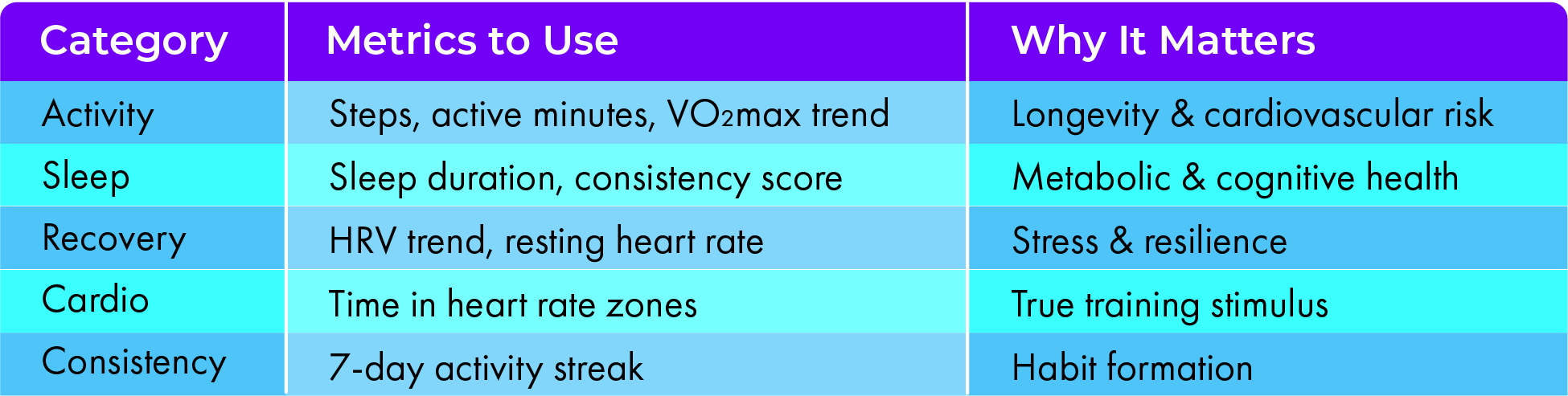
Pro tip: Favor trends and consistency over single-day spikes.
Step 2: Create a Points System That Rewards Behavior (Not Genetics)
One of the biggest mistakes companies make is rewarding fixed traits like naturally high VO₂max or baseline HRV.
Instead, reward:
Improvement
Consistency
Target-based effort
Behavior completion
Example Points Framework
Daily Movement
8,000 steps → 50 points
10,000 steps → 75 points
12,000+ steps → 100 points
Or better:
30 minutes in Zone 2–3 → 80 points
45+ minutes in Zone 2–4 → 120 points
Sleep Behavior
7–9 hours sleep → 70 points
5 consecutive days above 7h → 200 bonus points
Sleep consistency score >85 → 50 bonus points
Recovery / Stress
HRV above 30-day baseline → 40 points
Resting HR improving 5% over 60 days → 300 milestone points
Streak Mechanics
7-day movement streak → 150 bonus
30-day streak → 500 bonus
90-day streak → 2,000 bonus
Streaks build habit loops. Milestones create excitement.

Step 3: Introduce Tiers & Status Levels
This is where programs like Vitality excel:
Status creates emotional value beyond the reward itself.
Humans are highly motivated by ranking and progression.
Example Tier System
Bronze (0–5,000 points / year)
Access to basic rewards
Small gift cards
Digital badges
Silver (5,000–15,000 points)
Premium discounts
Fitness gear vouchers
Lower insurance copay options
Gold (15,000–30,000 points)
Wearable device discounts
Airline or travel points
Insurance premium reductions (1–3%)
Platinum (30,000+ points)
Major premium reductions (3–8%)
Annual health bonus
Exclusive partner perks
Concierge health services
Important:
Make tier thresholds achievable but challenging.
If users believe Platinum is impossible, motivation collapses.

Step 4: Design Rewards That Actually Matter
Points alone are meaningless. The reward must:
Have real-world value
Feel immediate
Be tied to identity
Categories of Effective Rewards
1. Financial Incentives
Insurance premium discounts
HSA contributions
Cashback
Reduced deductibles
This works particularly well for InsurTech.
2. Lifestyle Rewards
Gym memberships
Wearable discounts
Travel perks
Nutrition services
3. Experiential Rewards
Access to health retreats
Early product access
VIP features
4. Social Status Rewards
Public leaderboard
Community recognition
Ambassador programs
Never underestimate social signaling.

Step 5: Prevent Gaming & Fraud
If rewards have value, users will attempt to game the system.
Design safeguards:
Use heart rate validation for step rewards
Reward time in HR zones rather than raw steps
Use anomaly detection (sudden unrealistic jumps)
Require wearable-based verification (not manual input)
Consistency-based rewards are harder to game than volume-based ones.

Step 6: Balance Short-Term Motivation with Long-Term Health
A well-designed system should:
✔ Encourage daily activity
✔ Encourage long-term improvement
✔ Avoid overtraining
✔ Avoid unhealthy competition
For example:
Bad design:
Unlimited points for maximum activity (burnout risk)
Better design:
Diminishing returns after 60–90 minutes per day
Recovery bonus days
Rest-day points
You can even reward:
"Smart rest day taken when HRV is suppressed"
That builds trust and longevity.

Step 7: Align Rewards With Business Outcomes
This is where strategy matters most.
If you're an insurer:
Tie higher tiers to actuarial risk improvement
Monitor loss ratio by tier
Offer dynamic underwriting discounts
If you're a corporate wellness provider:
Tie points to absenteeism reduction
Offer employer-funded bonus pools
If you're a longevity app:
Tie rewards to biomarker improvements
Introduce long-term health scoring
Your reward system must create ROI, not just engagement.

Step 8: Annual Reset + Fresh Start Psychology
Many successful programs:
Reset points annually
Keep lifetime status badges
Re-open competition every January
This gives:
New members a fair chance
Existing members a fresh challenge
Gamification must evolve or it becomes stale.
Example: A Full Scoring Model
Here’s a simplified annual structure:
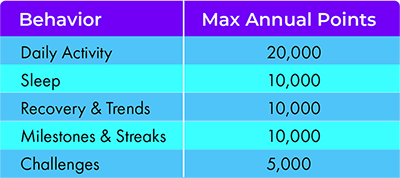
Total: 55,000 possible points
Platinum threshold: 30,000
This ensures high achievers must perform across categories — not just walk 20,000 steps daily.
Advanced Layer: Dynamic Personalization
The future of wearable rewards isn’t static scoring.
It’s adaptive:
Personalized goals based on baseline fitness
AI-adjusted difficulty
Improvement-based rewards
Risk-based incentive multipliers
Instead of:
“Everyone needs 10,000 steps”
You move toward:
“Improve your 30-day activity average by 12%”
That’s fair. And powerful.
Final Design Principles
Reward behavior, not biology
Reward consistency more than intensity
Use tiers to create aspiration
Tie incentives to real value
Protect against gaming
Align with business economics
Keep it simple enough to understand
The Strategic Advantage
Programs inspired by Vitality have proven that wearable-driven incentives can:
Reduce claims costs
Improve retention
Increase engagement
Create measurable health improvement
But the next generation goes further:
Personalized
Real-time
Data-driven
API-powered
Multi-device integrated
If implemented correctly, wearable data isn’t just a feature.
It becomes the engine of your engagement, underwriting, and growth strategy.