
Wearables for Predictive Insights
Wearable devices have evolved beyond simple tracking tools. What started as step counters and heart rate monitors is now becoming a foundation for something more powerful: predictive insights.
Instead of only telling users what has already happened, wearables are beginning to answer a more valuable question:
What is likely to happen next?
For companies building in digital health, insurance, wellness, or performance, this shift from tracking to prediction represents a major opportunity.
What are predictive insights in wearable data?
Predictive insights use historical and real-time data to identify patterns and estimate future outcomes.
With wearable data, this can include:
predicting fatigue or overtraining
anticipating illness or stress spikes
forecasting recovery needs
identifying long-term health risks
detecting anomalies before symptoms appear
This moves wearables from passive monitoring tools to decision-support systems.
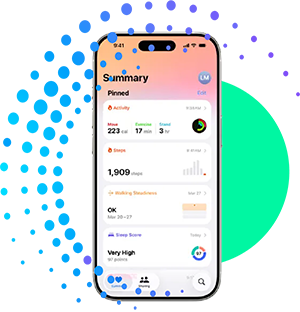
Why wearable data is ideal for prediction
Wearables generate a unique type of data that is especially suited for predictive models.
Continuous data streams
Unlike clinical data, wearables collect data continuously:
minute-by-minute heart rate
daily activity levels
nightly sleep patterns
This creates longitudinal datasets, which are critical for identifying trends.
Behavioral + physiological signals
Wearables combine:
behavior (activity, sleep habits)
physiology (HRV, heart rate, stress indicators)
This combination provides richer context for prediction.
Personal baselines
Over time, wearables establish individual baselines.
This allows systems to detect:
deviations from normal patterns
subtle changes that generic models might miss
Prediction becomes personalized, not population-based.
Key use cases for predictive insights
Early detection of health risks
Wearables can identify early signals such as:
elevated resting heart rate
decreased HRV
changes in sleep patterns
These signals can indicate:
illness onset
stress overload
recovery issues
Early detection enables earlier intervention.
Performance and recovery optimization
In fitness and performance, predictive insights can:
recommend when to train or rest
prevent overtraining
optimize recovery cycles
Instead of reactive adjustments, users receive proactive guidance.
Chronic condition management
For chronic conditions, predictive models can:
detect worsening trends
anticipate risk events
support continuous monitoring
This is especially relevant for:
cardiovascular conditions
metabolic disorders
respiratory issues
Insurance and risk prediction
In insurance, wearable data can power:
dynamic risk scoring
behavior-based underwriting
proactive risk mitigation
This enables a shift toward preventive insurance models.
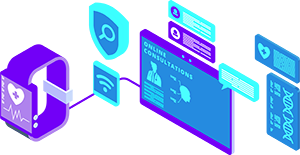
From signals to predictions: how it works
Turning wearable data into predictive insights requires multiple layers.
1. Data collection
Data is collected from multiple devices:
smartwatches
rings
fitness trackers
connected sensors
2. Data standardization
Different devices produce different formats.
Data must be:
normalized
aligned across devices
structured into comparable metrics
3. Feature extraction
Raw signals are transformed into meaningful features:
trends over time
variability metrics (e.g., HRV trends)
behavioral patterns
4. Modeling
Machine learning models analyze patterns to:
identify correlations
detect anomalies
generate predictions
5. Interpretation
Predictions must be translated into:
clear insights
actionable recommendations
user-friendly outputs

Challenges in building predictive systems
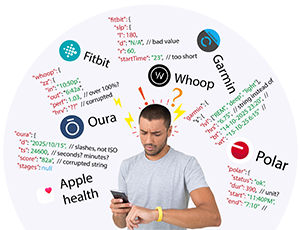
Data fragmentation
Multiple devices and platforms create integration complexity.
Without unified access, building predictive models becomes difficult.
Signal noise
Wearable data can be noisy due to:
device limitations
user behavior
inconsistent usage
Models must filter noise to extract reliable signals.
Lack of context
Data alone is not always enough.
External factors such as:
diet
environment
stress
illness
can affect signals and must be considered.
Trust and explainability
Users and organizations need to understand:
why a prediction is made
how reliable it is
Transparent models build trust.
The role of data infrastructure
Predictive insights depend on strong data infrastructure.
This includes:
unified APIs to access wearable data
standardized metrics across devices
scalable data pipelines
real-time processing capabilities
Some platforms in the ecosystem are already enabling developers to access standardized wearable data through a single integration, reducing the complexity of building predictive systems.
From prediction to action
Prediction alone is not enough.
The real value comes from actionability.
Effective systems should:
deliver timely recommendations
adapt to user behavior
close the feedback loop
For example:
“Your HRV has been decreasing for 3 days and sleep quality is declining. Consider reducing training intensity and prioritizing recovery.”
The future of predictive wearables
We are still in the early stages of predictive wearable systems.
In the coming years, we will likely see:
more accurate predictive models
integration with clinical data
personalized health forecasting
AI-driven coaching systems
real-time interventions
Wearables will move from tracking devices to personal health intelligence systems.
Final thoughts
The true value of wearable data is not in what it shows, but in what it can anticipate.
Predictive insights represent the next evolution:
from data → to insight
from insight → to prediction
from prediction → to action
Companies that can turn wearable signals into reliable, actionable predictions will define the next generation of digital health experiences.
And in that shift, wearables will become not just tools for monitoring, but systems for guiding better decisions every day.