
Wearables as continuous health monitoring systems
Wearable devices have evolved from simple activity trackers into continuous health monitoring systems. Instead of capturing isolated data points, they now allow health to be observed continuously, offering a new way to understand, prevent, and manage health.
This shift is transforming how digital health products, prevention models, and personalized experiences are designed.
From occasional measurements to continuous monitoring
Traditionally, health was assessed through occasional measurements such as medical visits, clinical tests, or self-reported checkups. Wearables change this paradigm by generating longitudinal data that reflects what happens between those moments.
The value lies not in a single data point, but in the ability to detect patterns, trends, and meaningful deviations over time.
Signals that enable continuous monitoring
Modern wearables capture a wide range of physiological and behavioral signals, including:
Heart rate and heart rate variability
Physical activity and movement levels
Sleep, rest, and recovery
Stress and physiological load indicators
Together, these signals help build a more complete view of daily health.
The role of personal baselines
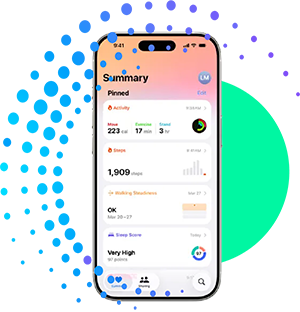
Continuous monitoring works by comparing individuals against their own historical data rather than against population averages. Personal baselines make it possible to interpret data correctly and detect meaningful changes.
A higher heart rate may be normal for one person and a warning signal for another. Individual context is essential.

From fitness to preventive health
While fitness was the first large-scale use case, continuous monitoring is expanding into:
Preventive health and early detection
Stress management and mental health
Longevity and long-term well-being
Chronic condition monitoring
Wearables make it possible to act before clear symptoms appear.
Integration with AI and advanced analytics
The real potential of continuous monitoring is unlocked when wearable data is combined with AI and advanced analytics. Models can identify complex patterns, anticipate risk, and deliver personalized recommendations.
This requires data that is standardized, high quality, and properly contextualized.

Challenges of continuous health monitoring
Despite its potential, continuous monitoring faces key challenges:
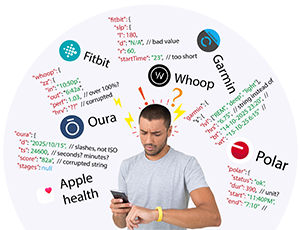
Data fragmentation across devices
Measurement quality and consistency
Privacy and consent management
Responsible interpretation of insights
Addressing these challenges is essential for scaling continuous health solutions.
APIs and platforms as enablers
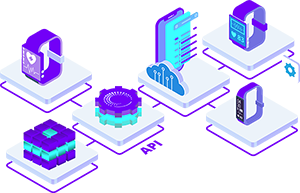
The technical complexity of integrating multiple wearables makes APIs and data platforms critical enablers. These layers unify data, abstract device differences, and provide information ready for product development, analytics, and AI.
Without this infrastructure, continuous monitoring becomes difficult to maintain and scale.
The future of continuous monitoring
As sensors improve and AI models evolve, wearables will become persistent interfaces between the human body and digital systems.
Continuous monitoring will move from being a differentiator to becoming a standard in digital health products.
Conclusion
Wearables are no longer consumer gadgets. They are continuous health monitoring systems that enable a shift from reactive care to more proactive and personalized health management.
Companies that understand this shift and build on continuous, reliable, and well-integrated data will be best positioned to lead the next phase of digital health.