Blog
Understanding wearable health metrics and data types
Wearable devices generate a large volume of health and behavioral data. However, not all metrics are defined, calculated, or structured in the same way.
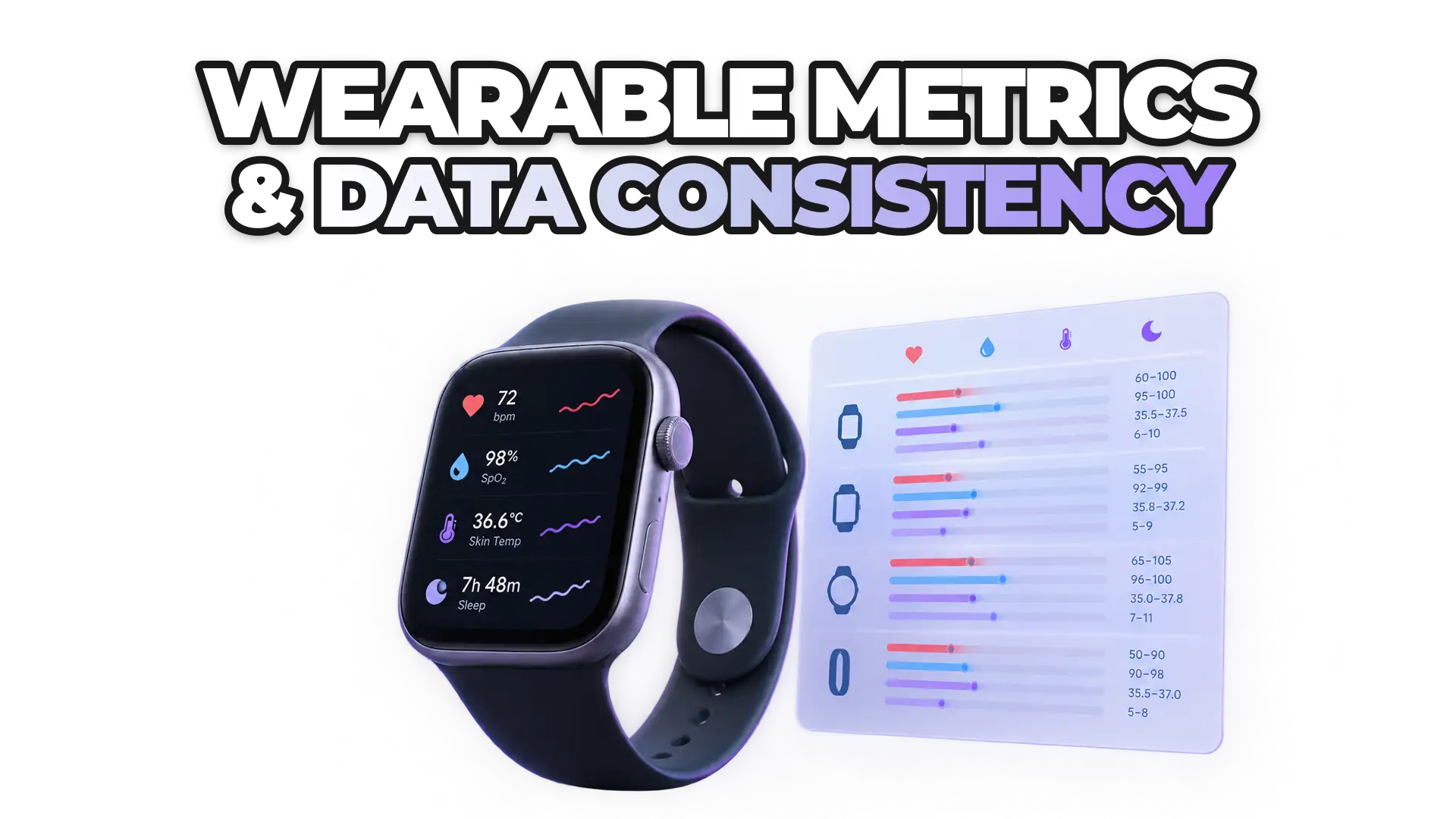
Wearable devices generate a large volume of health and behavioral data. However, not all metrics are defined, calculated, or structured in the same way. For product and engineering teams, understanding these differences is essential to building reliable and scalable solutions — and it is one of the real challenges of working with wearable data, from access to trust.
In this article, we explain the main types of wearable health metrics, how they differ across devices, and why standardization is critical when integrating wearable data into your application. If you want the device-by-device view first, our guide to the particularities of each wearable health data source covers what changes from one manufacturer to the next.
What are wearable health metrics?
Wearable health metrics are quantitative indicators derived from biometric signals captured by connected devices such as smartwatches, rings, bands, and patches.
These devices collect raw signals through sensors. Manufacturers then process those signals into higher-level metrics that applications can consume. Before choosing which ones to use, it helps to understand how to access health data from wearables in the first place.
It is important to distinguish between:
Raw sensor data
Manufacturer-calculated metrics
Standardized metrics prepared for cross-device comparison
Each layer introduces variability that can affect product logic and analytics. That variability multiplies quickly once you work across 400+ supported wearables and health data sources, each with its own extraction method.
Core categories of wearable metrics
Although manufacturers differ in implementation, most wearable data falls into five main categories. For a deeper breakdown, see our guide to wearable data types: activity, sleep, HRV, temperature, and more.
1. Cardiovascular metrics
These metrics are derived from optical or electrical heart sensors.
Common examples include:
Heart rate
Resting heart rate
Heart rate variability (HRV)
Heart rate zones
Considerations:
HRV calculation methods vary between manufacturers.
Sampling frequency differs across devices.
Some metrics are averaged, while others are interval-based.
Without normalization, comparing HRV from two devices may produce misleading conclusions. If HRV is central to your product, it is worth understanding how HRV is tracked and improved before you model it.
2. Sleep metrics
Sleep tracking is one of the most widely used wearable features.
Common sleep metrics include:
Total sleep duration
Sleep stages (light, deep, REM)
Sleep efficiency
Sleep interruptions
Challenges:
Sleep stage classification is proprietary.
"Deep sleep" definitions are not standardized.
Devices use different algorithms and thresholds.
Applications that rely on sleep insights must account for these structural differences. Our breakdown of how wearable biomarker data is structured shows how sleep summaries and events are organized once normalized.
3. Activity metrics
Activity data measures movement and physical output.
Typical activity metrics include:
Steps
Distance
Calories burned
Active minutes
Activity intensity
Considerations:
Calorie estimation models vary significantly.
Step detection algorithms differ by device.
Some manufacturers classify activity levels differently.
For longitudinal analysis, consistency across devices is more important than absolute precision. The same applies to phone-based sources: Apple Health and Health Connect count and store activity differently, and our biomarker data structure guide explains how those differences are reconciled into a single schema.
4. Recovery and readiness metrics
Some manufacturers provide composite scores that summarize physiological state.
Examples:
Recovery score
Readiness score
Strain score
Body battery
These metrics are:
Derived from multiple signals
Calculated using proprietary algorithms
Not directly comparable across brands
If your product depends on recovery indicators, you must evaluate whether to rely on manufacturer scores or compute your own standardized models. A vendor-neutral alternative is a scoring engine that runs on normalized inputs: ROOK Score 2.0 calculates physical, sleep, and body health pillars using the same definitions for every device, and our article on ROOK's health score explains the reasoning behind it.
5. Oxygen saturation and respiratory metrics
These metrics are often used in wellness, performance, and research contexts.
Common examples:
SpO₂
Respiratory rate
Breathing disturbances
Important factors:
Measurement conditions affect reliability.
Some devices collect spot readings, others continuous readings.
Environmental factors can impact accuracy.
Understanding data granularity is critical for interpretation, especially when wearables are used as continuous health monitoring systems rather than occasional measurement tools.
Device-reported metrics vs. standardized metrics
When integrating wearable data, you typically encounter two approaches.
Device-reported metrics
These are values calculated and delivered directly by the manufacturer's API.
Advantages:
Easy to access
No additional processing required
Limitations:
Not comparable across devices
Definitions may change with firmware updates
Limited transparency into calculation methods
This is the root of a familiar problem: wearable data is messy, and it has to be normalized before it can be trusted in production.
Standardized metrics
Standardized metrics are normalized indicators that follow consistent definitions across devices.
Advantages:
Comparable across manufacturers
Stable definitions
Suitable for analytics and modeling
Standardization reduces fragmentation and simplifies downstream product logic. In practice this means a unified data model on top of every provider — the approach described in the ROOKConnect documentation — and a repeatable method for standardizing health data from devices.
Why metric definitions matter
Small differences in definitions can significantly impact outcomes.
For example:
One device may define "active minutes" as any movement above a low threshold.
Another may require moderate intensity sustained for a minimum duration.
If your platform aggregates users from multiple devices, inconsistent definitions can distort:
Risk models
Personalization logic
Engagement analytics
Predictive modeling
Clarity in metric definitions directly affects product reliability — and it is one of the reasons health data quality matters well before the analytics layer. It matters even more if the output feeds a model: AI-ready wearable data depends on definitions that stay stable across devices and over time.
Raw data vs. derived insights
Raw sensor data typically includes:
Time-stamped heart rate readings
Motion sensor data
Signal amplitude
Derived insights include:
Daily resting heart rate
Weekly sleep averages
Recovery indicators
While raw data provides flexibility, it requires significant processing — including data integrity work such as handling duplicate records across sources. Derived metrics reduce complexity but increase dependency on manufacturer logic. The trade-off between the two is what turns steps into clinical-grade insights.
Many organizations choose a hybrid model:
Access structured metrics for efficiency
Maintain consistent definitions for comparability
Key considerations when working with wearable metrics
Before integrating wearable data, evaluate:
Metric definition transparency
Sampling frequency
Data granularity
Historical depth
Update frequency
Cross-device comparability
These factors determine whether your data pipeline will support scalable analytics and product growth. Ignoring them is what creates the hidden costs of fragmented wearable data later on. If you want to inspect real data before committing to an architecture, the ROOK Extraction App lets you collect from mobile and API-based sources without building a native app first.
How we approach wearable metric standardization at ROOK
At ROOK, we focus on delivering structured, usable wearable data through a single API for hundreds of wearables.
Our approach includes:
Aggregating data from multiple manufacturers
Normalizing metric structures
Maintaining consistent definitions
Reducing integration overhead
By standardizing wearable health metrics, we help teams focus on building products rather than managing fragmented data pipelines. You can see how that plays out in production across use cases and industries, from digital health and fitness to insurance.
We also discuss these trade-offs in the open: our podcast and media hub covers secure health data integrations and whether you can trust your wearable, earlier episodes explore how wearables are reshaping healthcare and what a universal language for health tech looks like, and our partner conversations show how insurers and digital health companies unlock wearable data in practice.
Final thoughts
Understanding wearable health metrics is the foundation of any wearable data strategy. Not all metrics are equivalent, and not all devices calculate them in the same way.
If your platform depends on wearable data, standardization, clarity, and consistency are not optional. They are requirements for building reliable and scalable solutions.
If you are evaluating how to integrate wearable data into your product, the next step is understanding how wearable APIs work and how to design a unified integration architecture — starting with why your health platform needs a unified API and how to integrate data from multiple wearables into one system.
 Written byJuana Carolina Ordoñez MerchanInternal Digital Marketing