Wearable data ready for the clinical record

ROOK's EHR/EMR API delivers each user's health data as FHIR R4, with LOINC codes and UCUM units, ready to integrate into clinical systems.

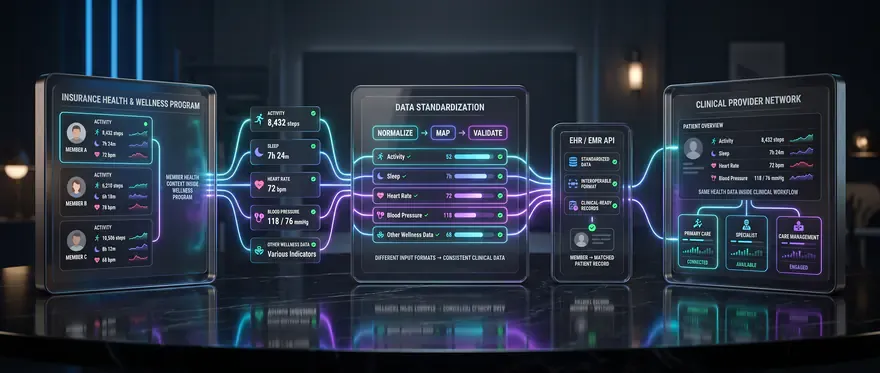
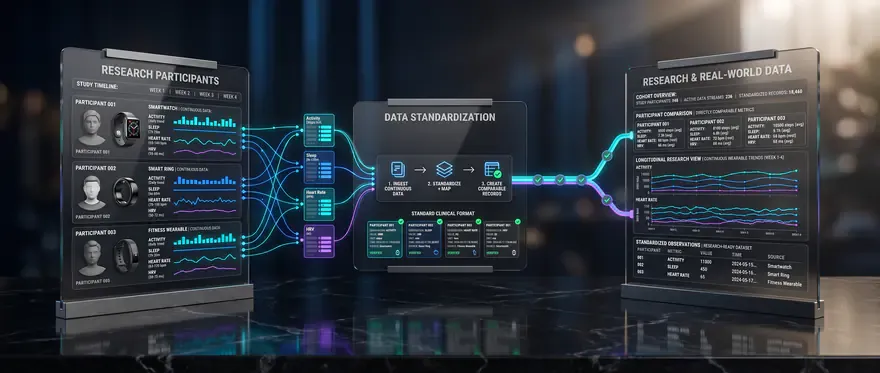
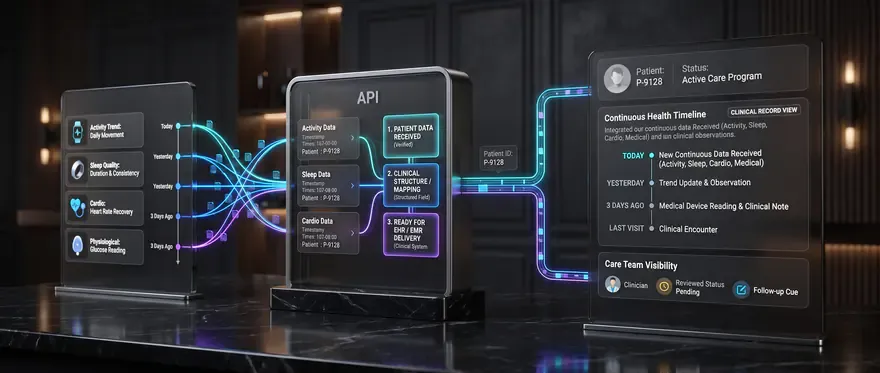
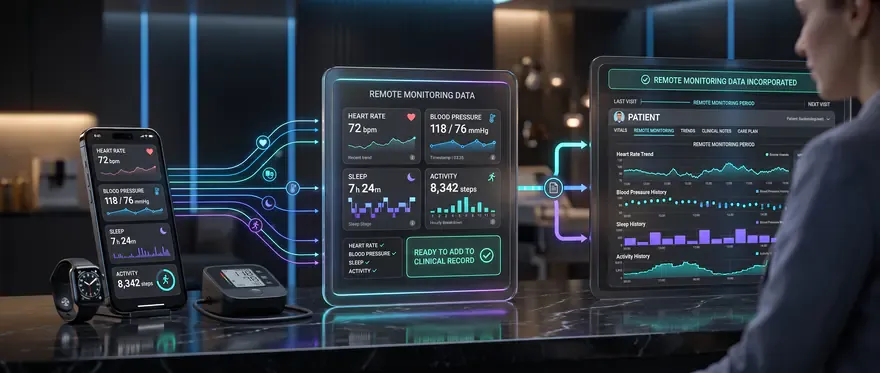
Data from wearables and health apps flows into ROOK Connect and leaves as a FHIR R4 document, headed to the clinical record.

How it works

Wearable data reaches the clinical record in three steps

Clinical systems record what happens during a visit. ROOK adds what happens between visits: continuous activity, sleep, and vital sign data, delivered in the format those systems already understand.

  1. Users connect their sources

    Users connect their wearables and health apps through ROOK Connect.

  2. ROOK translates to FHIR

    With every new or updated summary, ROOK turns the available metrics into standardized clinical observations.

  3. Your backend receives FHIR R4

    The FHIR document reaches the backend through the same Data Webhook the integration already uses, ready to be sent to the clinical system.

Continuous data, in clinical language

Three health pillars, as FHIR observations

Every metric with an available LOINC code is delivered as an individual FHIR observation, ready to be read by any compatible system.

  • Body Health

    Weight, height, BMI, blood pressure, resting heart rate, oxygen saturation, and caloric intake.

  • Physical Health

    Steps, distance, average heart rate, VO₂max, and oxygen saturation.

  • Sleep Health

    Sleep duration and stages, breathing rate, oxygen saturation, and time to fall asleep.

FHIR ObservationSimplified example
{  "resourceType": "Observation",  "status": "final",  "code": {    "coding": [{      "system": "http://loinc.org",      "code": "8867-4",      "display": "Heart rate"    }]  },  "valueQuantity": {    "value": 94,    "unit": "beats/min",    "system": "http://unitsofmeasure.org"  }}
Benefits

Daily wearable data, in the standards clinics already use

FHIR R4, LOINC, and UCUM documents that update with every new summary, on the ROOK Connect integration and webhook you already run.

  • Data no EHR has

    Activity, sleep, and vital signs measured every day, not just on the day of the visit.

  • Standards health systems already use

    FHIR R4, LOINC, and UCUM, with no proprietary formats to translate.

  • No additional integration

    It runs on top of the ROOK Connect integration and arrives through the same webhook.

  • Always up to date, no duplicates

    The document updates with every new summary and only creates a new version when the clinical content changes.

Use cases

Programs that bring continuous data into clinical care

Digital health, remote monitoring, insurance, and research teams send wearable data to clinical systems in the format those systems read.

Coming soon

Coming next: EHR and EMR data flowing into ROOK

Today the EHR/EMR API delivers wearable data to clinical systems. Soon, ROOK Connect will also bring data from EHR and EMR systems into ROOK, alongside each user's continuous data.

  • Clinical records into ROOK

    Data from EHR and EMR systems, brought into ROOK Connect through the same integration.

  • One user, every source

    Clinical records linked to the same user as their wearable and lab data.

  • Data in both directions

    Wearable data flows out to clinical systems, and clinical data flows into ROOK.

EHR/EMR API

What happens between visits, in the clinical record.

The EHR/EMR API turns the data already flowing through ROOK Connect into standardized clinical information, ready for health systems.

Read more in our technical documentation

FAQ

Frequently asked questions about the EHR/EMR API

What the EHR/EMR API delivers today and what comes next.

What is the ROOK Connect EHR/EMR API?

The EHR/EMR API delivers the wearable data already flowing through ROOK Connect to clinical systems as FHIR R4, through the Clinical Ready capability. Bringing data from EHRs, EMRs, patient portals, and health networks into ROOK is coming soon.

In what format does the EHR/EMR API deliver data?

For wearable data sent to clinical systems, ROOK delivers a FHIR R4 Bundle through the Data Webhook for metrics that can be mapped. For records that will come from EHR and EMR systems, ROOK anticipates structured clinical information with FHIR R4 interoperability, and resources may vary by provider.

What clinical data will ROOK bring in from EHR and EMR systems?

Availability will depend on the source and authorized access. The intended scope includes information useful for longitudinal records, intake automation, care coordination, and personalized experiences.

Which EHRs, EMRs, or health networks will ROOK connect?

ROOK will publish supported EHR, EMR, and health-network sources when the capability launches. Teams that need a specific source can share it with the ROOK team today.

Talk to the ROOK team

How will users authorize access to their medical records?

The flow will depend on the clinical provider and applicable requirements. In general, users will authenticate and authorize the relevant access. ROOK and the customer may only use data permitted by that flow and the applicable contractual relationship.

What factors can affect medical-record retrieval?

Medical-record retrieval can vary by provider, portal availability, user identity, permissions, historical coverage, and source quality. Customers should not assume that every record or provider will deliver the same resources.

Still have questions?Our team can review your sources and use case with you.
Schedule a demo

ROOK structures and standardizes available health data. Clinical interpretation and care decisions remain with qualified healthcare professionals.

Newsletter

Stay in the loop.

Sign up with your email address to receive news and updates from the ROOK team.

We respect your privacy. Read our privacy policy.