
How to integrate wearables into clinical workflows (without breaking your stack)
Wearable devices have evolved from consumer fitness trackers into valuable sources of health information. Heart rate, sleep, activity, blood oxygen, glucose, blood pressure, and other biomarkers are increasingly being used to support clinical decision-making, remote patient monitoring, preventive care, and personalized treatment plans.
But integrating wearable data into clinical workflows is rarely straightforward.
Engineering teams often underestimate the complexity of working with multiple wearable ecosystems, health platforms, and clinical standards. What begins as a simple API integration can quickly become a long-term maintenance burden — one that slows down product development and makes it harder to prove clinical value.
This is particularly relevant for organizations building under the ACCESS model, where the goal isn't just data collection. It's demonstrating measurable outcomes. And that's only possible when the data underneath is reliable, standardized, and traceable.
This article explores the technical challenges of integrating wearable data into clinical workflows and how the right architecture makes it possible to move from raw data to real outcomes.
The challenge isn't connecting devices — it's standardizing data
Most wearable vendors provide APIs that allow developers to access health data. On the surface, integration appears simple.
In reality, every ecosystem behaves differently.
Each platform has its own:
Authentication flow
Data model
Historical data availability
Update frequency
Rate limits
Permission model
Supported metrics
Data quality standards
For example, a patient may connect data from:
Apple Health
Health Connect
Garmin
Fitbit
Oura
WHOOP
Dexcom
Abbott
Polar
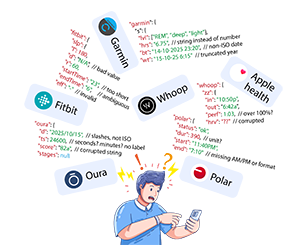
Although each platform provides similar health information, the underlying structure is completely different. Sleep isn't calculated the same way. HRV definitions vary. Activity units don't always match.
This creates significant engineering overhead when applications need to support multiple sources — and makes it nearly impossible to compare outcomes across patients or devices without a normalization layer in place.
Related: Why the ACCESS Model Needs Standardized Wearable Data
Clinical workflows require more than raw data
Healthcare applications cannot rely on raw wearable data alone.
Under the ACCESS model, clinical programs need to track progress, generate reports, and validate interventions with consistency. That means the data coming in from devices must be interpreted the same way across all patients, all devices, and all time points.
Engineering teams must normalize:
Units of measurement
Time zones
Device metadata
Biomarker names
Missing values
Duplicate records
Historical synchronization
In addition, healthcare interoperability requires compliance with standards such as:
FHIR R4 — for structured health data exchange
LOINC — for standardized clinical terminology
UCUM — for consistent units of measurement
Without this normalization layer, integrating wearable data into Electronic Health Records (EHRs) or clinical dashboards becomes difficult, expensive, and unreliable.
Related:ACCESS Model: From data collection to measurable outcomes
The hidden cost of point-to-point integrations
Many organizations begin by integrating each wearable individually. The architecture usually looks like this:
Apple Health → App
Garmin           → App
Fitbit               → App
Oura                → App
WHOOP         → App
This approach works at first. As more devices are added, complexity grows rapidly.
Every new integration introduces:
New authentication flows
Different API update cycles
Additional testing requirements
New maintenance overhead
Separate monitoring logic
Vendor-specific edge cases
The result: instead of building clinical features or proving outcomes, engineering teams spend their time maintaining integrations. Under the ACCESS model, that's a direct threat to the product's ability to deliver value — because fragmented, inconsistent data cannot support reliable outcome measurement.

A standardized integration layer changes everything
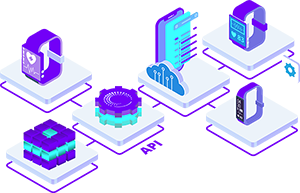
Rather than integrating every wearable independently, organizations can adopt a centralized health data infrastructure.
A unified integration layer provides:
One API
One authentication model
Standardized health metrics across all devices
Consistent historical data handling
Normalized device metadata
Simplified long-term maintenance
Instead of managing dozens of integrations, product teams can focus on what actually matters: building clinical experiences, tracking patient progress, and proving outcomes.
This is the infrastructure foundation that ACCESS model programs depend on. Without it, even the best product experience cannot deliver measurable results at scale.

Preparing wearable data for clinical use
Clinical workflows — and ACCESS model reporting in particular — require more than activity data. Healthcare providers need information that is reliable, traceable, standardized, and interoperable.
That means wearable data must be enriched with:
Standard clinical terminology
Metrics should map to recognized standards such as LOINC, making data interpretable across systems and providers.
Standard units
Measurements must follow UCUM conventions to ensure comparability across devices and patient populations.
Source attribution
Every data point should indicate where it originated — which device, which platform, and when — so that clinical teams can assess data quality and trace outcomes back to their source.
Structured exports
Clinical applications increasingly expect data in formats such as FHIR R4 Bundles, which can be consumed by EHR systems and analytics platforms without additional transformation.
Related:How to Track Outcomes for ACCESS: BP, HbA1c, Activity, and More
Designing for scalability
Many teams optimize for their first integration. Few optimize for their fiftieth.
As organizations expand into remote patient monitoring, chronic disease management, digital therapeutics, and preventive care, they inevitably need to support more devices, more patient populations, and more data sources.
A scalable architecture should make it easy to:
Add new wearable providers
Introduce medical devices
Incorporate laboratory data
Connect EHR systems
Support future interoperability standards
All without redesigning the application every time a new data source is added. For ACCESS model programs specifically, this scalability isn't optional — it's the difference between a pilot that works and a program that can grow.
Related:What ACCESS Model Companies Need to Build Before Go-Live
How ROOK simplifies clinical integration
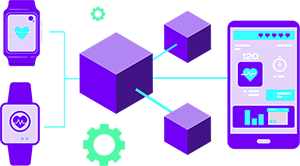
ROOK provides the infrastructure needed to integrate wearable and health data into clinical workflows through a single standardized platform.
With ROOK Connect, organizations can access health data from hundreds of wearable devices and health platforms through one integration, eliminating the complexity of managing multiple APIs and ensuring that data is clean, consistent, and comparable from day one.
As clinical requirements evolve, ROOK helps standardize health data using healthcare-recognized standards, making it easier to prepare information for interoperability with clinical systems and future EHR integrations. This means teams building ACCESS model programs can focus on outcome measurement, reporting, and patient engagement — not on data plumbing.
By providing a consistent foundation for wearable health data, engineering teams can spend less time maintaining integrations and more time building products that demonstrate real clinical impact.
From data collection to proven outcomes
Wearables are becoming an essential component of modern healthcare — and the ACCESS model is accelerating that shift. The organizations that succeed won't necessarily be the ones connecting the most devices. They'll be the ones that can efficiently transform fragmented health data into standardized, interoperable information that fits seamlessly into clinical workflows and actually proves results.
Choosing the right health data infrastructure today reduces engineering complexity, accelerates product development, and prepares your platform to meet the outcome-driven expectations that clinical programs now demand.
Want to simplify wearable integration for your clinical platform?
Learn how ROOK Connect helps organizations standardize health data from hundreds of wearables, health apps, and medical devices through a single integration.
👉 Explore ROOK:https://www.tryrook.io