Blog
What Is ROOKScore 2.0 and How Is It Calculated?
ROOKScore 2.0 scores Physical, Sleep and Body Health from wearable data on a 0 to 100 scale, plus a global and 7-day score.
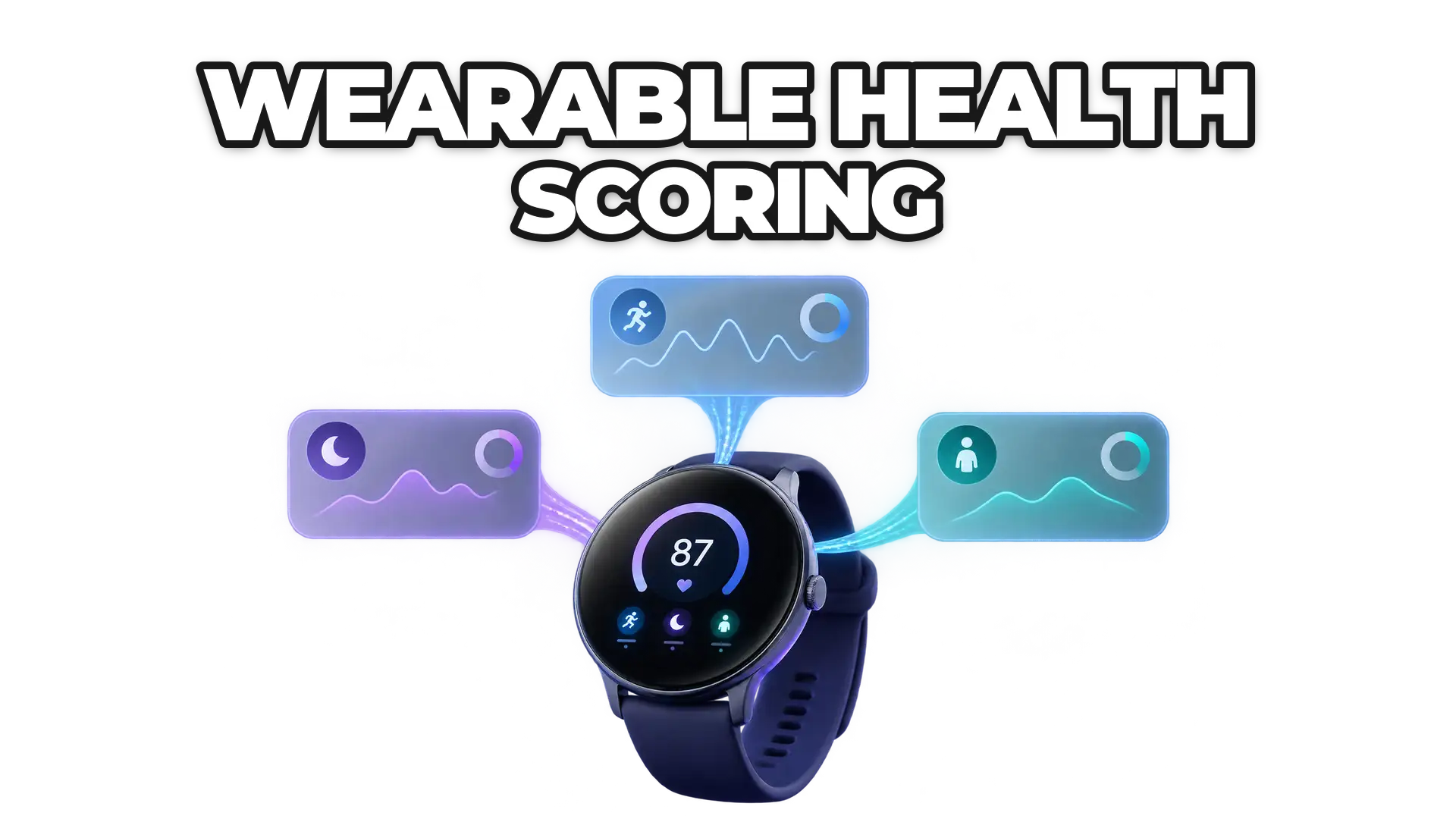
ROOKScore 2.0 is ROOK's health score built from wearable data. ROOKScore 2.0 scores three pillars, Physical Health, Sleep Health and Body Health, each on a scale from 0 to 100, using physical, sleep and body health summaries plus age, sex, height and weight. ROOKScore 2.0 averages the three pillars into a global score and a 7-day score, so users can track their wellbeing over time.
What data does ROOKScore 2.0 use?
ROOKScore 2.0 uses data from three summaries, one per pillar:
- Physical Health
- Data Source: Physical health summaries
- Goal: To provide an indicator of the percentage of daily activity, calories burned, and steps taken.
- Required Data: Age, gender, weight, height.
Activity Score: Based on the amount of physical activity throughout the day, with a focus on meeting daily activity goals.
Calories Score: Based on the number of calories burned, both passively and through activity.
Steps Score: Calculated based on daily step count.
- Body Health
Data Source: Body health summaries
Goal: To evaluate the user’s body mass index (BMI) and overall physical health.
Required Data: Height, weight.
BMI Score: Calculated based on the user’s height and weight.
- Sleep Health
Data Source: Sleep health summaries
Goal: To assess the quality, duration, and recovery of sleep.
Required Data: Age, gender.
Readiness Score: Indicates how ready the user is for the day, based on sleep quality and overall sleep patterns.
Sleep Duration Score: Measures the duration of the user’s sleep the night before.
Sleep Quality Score: Based on how well the user’s sleep quality was during the previous night.
What scores does ROOKScore 2.0 return?
ROOKScore 2.0 returns these output scores:
Global Score: An average of the scores from the Physical Health, Sleep Health, and Body Health pillars, providing an overall view of health.
7-Day Score: An average of the global score over the past seven days.
Physical Health Score: Reflects the user’s overall physical health, calculated from activity, calories burned, and steps taken.
Body Health Score: Provides an evaluation of the user’s body health based on their BMI.
Sleep Health Score: Reflects the user’s sleep health, providing an overall evaluation based on readiness, sleep duration, and sleep quality.
What standards are ROOKScore 2.0 metrics based on?
ROOKScore 2.0 references global health guidance from organizations such as the World Health Organization (WHO) so its metrics stay relevant and aligned with current health science.
How is ROOKScore 2.0 calculated in an example?
To illustrate how ROOKScore 2.0 works, the example below uses a 28-year-old woman, 165 cm tall and weighing 64 kg, with a mixed lifestyle (partially active and partially sedentary).
Note: ROOKScore 2.0 needs basic demographic data to reflect an individual accurately. When age, sex, height and weight are available, ROOKScore 2.0 tailors calculations to the user's profile (for example, calorie and activity goals adjusted to body size; sleep and HRV ranges aligned to age and sex). If any of these values are missing, ROOK uses general reference values; the score stays directionally useful but loses personalization and is flagged as calculated with incomplete data.
Calories Score:
- “calories_score”: {
- “datetime_string”: “2023-12-28T21:07:14.402999Z”,
- “created_at_string”: “2023-12-28T21:07:14.402999Z”,
- “updated_at_string”: “2023-12-28T21:07:14.402999Z”,
- “score_0_100_int”: 80,
- “calculated_with_missing_user_info_bool”: false,
- “missing_user_info_array”: []
The calories score is based on total calories burned during the day, compared to a target personalized to the user’s demographic profile. A score of 100 means the goal was fully met or exceeded. Lower values reflect a proportion of the target achieved. In this case, moderate calorie expenditure that fell short of the target resulted in a mid-range score.
Activity score
“activity_score”: {
“score_0_100_int”: 90,
The activity score uses a daily minimum target of 30 minutes of activity. Reaching or exceeding that duration results in a score of 100. If the duration is shorter, the score is scaled accordingly. In this example, the user reached approximately 90% of the activity goal, yielding a score of 90.
Steps score
“steps_score”: {
“score_0_100_int”: 100,
The steps score compares the user's total daily steps against a baseline of 10,000 steps. In this example, the user reached or exceeded the baseline, resulting in a score of 100.
Physical health score
“physical_health_score”: {
“calories_score”: {…},
“activity_score”: {…},
“steps_score”: {…}
The physical health score combines calorie expenditure, active minutes, and daily steps on a 0 to 100 scale. A score of 90 reflects a strong performance: the user met or exceeded the step goal, completed most of the activity goal (≈30 minutes), and nearly reached the calorie expenditure target. If any sub-score is unavailable, the system averages the available metrics.
BMI score
“bmi_score”: {
The BMI score reflects the user’s Body Mass Index, calculated from height and weight and compared to a standard healthy range. A score of 100 indicates the user’s BMI falls within that healthy range. In this case, the individual has a BMI of approximately 23.5, which is within the optimal range.
Body health score
“body_health_score”: {
“bmi_score”: {…}
A body health score of 100 confirms that the user’s BMI is in the healthy range, based on their height and weight profile. For the example (female, 28 years old, 165 cm, 64 kg), the BMI is approximately 23.5, resulting in the highest possible score for this pillar.
Sleep duration score
“sleep_duration_score”: {
“score_0_100_int”: 84,
The sleep duration score compares hours slept against an age-adjusted recommended range. A score of 84 suggests that the user came close to meeting the target but did not fully achieve it.
Sleep quality score
“sleep_quality_score”: {
The sleep quality score is based on the amount of deep sleep achieved relative to a recommended target. A score of 80 indicates reasonably good quality—though not optimal—and may reflect brief interruptions, lower efficiency, or slightly reduced deep sleep time.
Readiness score
“readiness_score”: {
“score_0_100_int”: 82,
The readiness score estimates how recovered the user is in the morning, using nighttime heart rate variability (HRV) as the primary input. A score of 82 suggests good recovery—HRV is near the expected range but not at optimal levels. A score of 100 would indicate ideal overnight recovery.
Sleep health score
“sleep_health_score”: {
“sleep_duration_score”: {…},
“sleep_quality_score”: {…},
“readiness_score”: {…}
The sleep health score combines duration, quality, and readiness into a single metric on a 0 to 100 scale. A score of 82 reflects solid overall sleep: duration (84), quality (80), and readiness (82) all indicate good but not optimal rest. If any sub-score is missing, the available scores are averaged.
Overall score
“overall_scores”: {
“global_score_0_100_int”: 90,
“seven_days_avg_score_0_100_int”: 84
The overall score includes two metrics:
global_score_0_100_int: A snapshot of today’s overall health score across the three pillars—physical, sleep, and body—scaled from 0 to 100. A score of 90 indicates a strong day overall.
seven_days_avg_score_0_100_int: A rolling average for the past seven days. A score of 84 reflects consistent, positive habits. The higher daily score (90) suggests today outperformed the recent trend, indicating improvement or an exceptional day.
Does ROOKScore 2.0 include mental health?
No. ROOKScore 2.0 focuses on physical, sleep and body metrics. ROOK recognizes that mental wellbeing, such as stress levels and emotional wellbeing, is part of a holistic view of health.
How is health measurement evolving?
Health data measurement is moving toward personalized insights that include metrics like glucose levels, hydration status and body composition, which are shaping digital health measurement.
How does ROOKScore 2.0 help users?
ROOKScore 2.0 combines health science principles, wearable data and a holistic approach to give users a clear view of their activity, sleep and body health, so they can make informed decisions about their wellness and follow their progress. ROOK moves and standardizes the data; it does not diagnose or replace clinical judgment.
For the related score explained from the start, read understanding ROOK's health score.
To see how ROOKScore 2.0 fields are delivered, read the ROOK developer documentation, or contact the ROOK team.
 Written byDaniel MasDigital Marketing Lead