Blog
How Do You Train AI Models with ROOK Data?
How to train AI models on ROOK's standardized wearable data: collection, cleaning, feature engineering, training, validation and deployment.
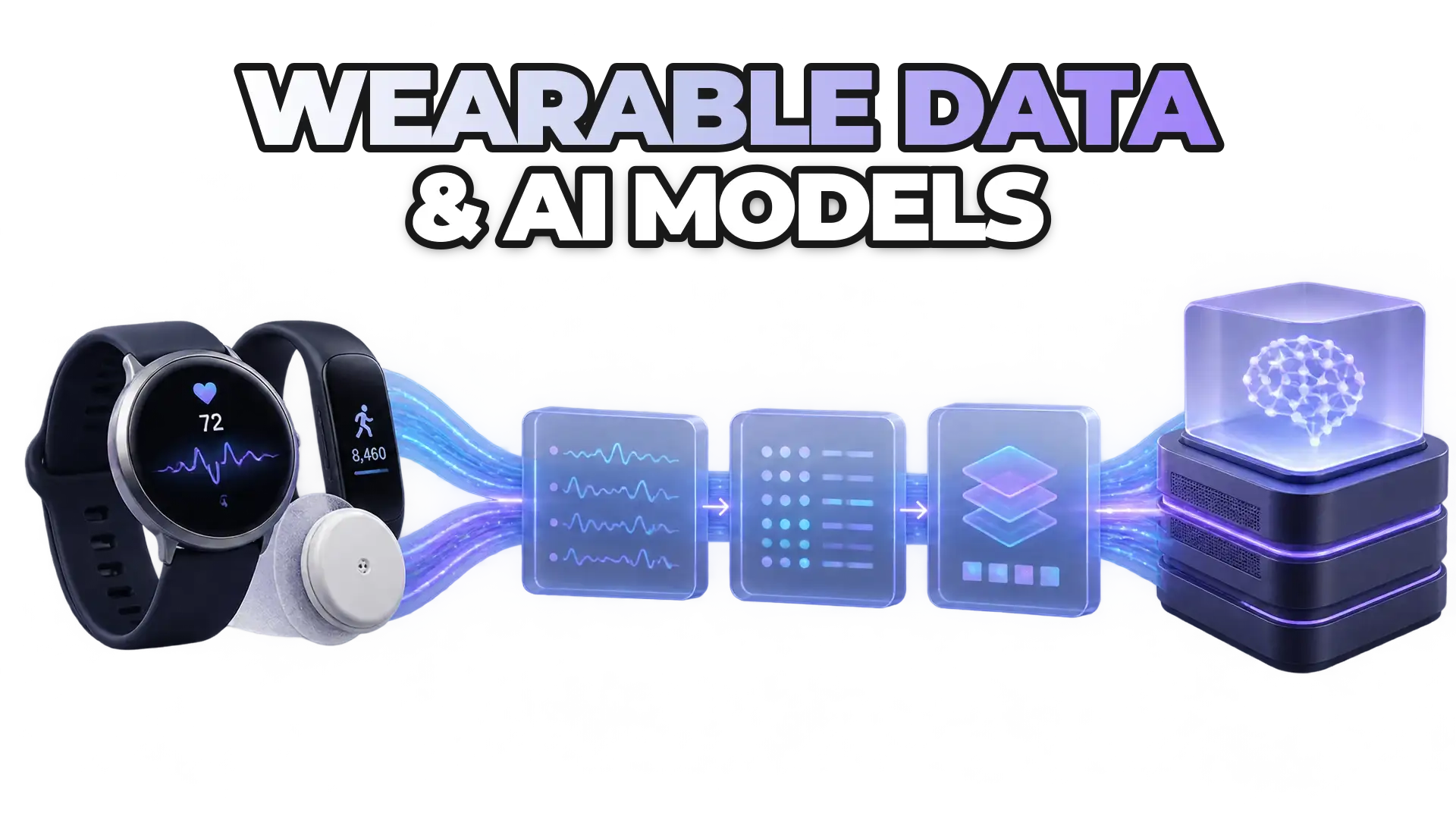
Training an AI model with ROOK data takes six steps: collect standardized wearable data through the ROOK API, clean it by handling missing values and outliers, engineer features such as HRV, activity and sleep stages, train with supervised, unsupervised or reinforcement learning, validate with cross-validation and metrics like precision and recall, then deploy the model inside a health app to deliver personalized insights.
Wearables track steps, heart rate, sleep patterns and stress levels, but to unlock that data it must be analyzed intelligently, which is where Artificial Intelligence (AI) comes in. By combining ROOK's wearable health data API with machine learning models, developers can build applications that deliver personalized health insights to guide users' lifestyle choices.
What makes ROOK data suited to AI models?
ROOK data suits AI models because ROOK delivers data from devices like Fitbit, Garmin, Apple Watch, Dexcom and Oura in one standardized format, so the data arrives consistent, clean and ready for analysis. ROOK supports 72 data sources and more than 500 devices.
Four properties make ROOK data useful for AI model training:
- Standardized data: ROOK standardizes heart rate, activity levels, sleep patterns and more across devices, so developers can build models instead of handling multiple data formats.
- Broad range of metrics: ROOK delivers activity, sleep quality, heart rate variability, stress levels and other health metrics, so models can consider a wide array of health factors.
- Continuous data: ROOK delivers new data as wearables sync, so applications can generate timely insights from recent information.
- Scalability: ROOK's API is designed to scale from a few users to a global audience, which matters when models must handle large data volumes across different populations.
What are the steps to train an AI model for personalized health insights?
Training an AI model for personalized health insights runs from data preparation to model deployment in six steps.
1. How do you collect and integrate ROOK data?
Developers collect data from wearable devices through the ROOK API, which consolidates multiple devices into a single, unified format. Metrics such as sleep cycles, activity levels, calories burned and heart rate can be pulled from a wide range of devices and aggregated in one place.
2. How do you clean wearable data for training?
Cleaning wearable data removes inconsistencies before the data reaches an AI model, so the model trains on accurate, reliable and consistent inputs. Data cleaning involves:
- Handling missing data: when a device did not capture continuous data (device removal, connectivity issues), imputation or removal of incomplete records may be required.
- Removing outliers: wearables sometimes produce erroneous or extreme data points from misreadings or sudden movements, which should be removed before training.
3. How do you engineer features from wearable data?
Feature engineering transforms raw wearable data into meaningful inputs an AI model can use. For example:
- Heart rate variability: HRV-based features are commonly used as indicators of stress and recovery.
- Activity levels: combining data from multiple devices gives a more complete view of a user's daily activity.
- Sleep patterns: sleep stages (REM, light, deep) and overall sleep quality add context on recovery.
4. How do you train the AI model?
Once the data is clean and features are engineered, the model can be trained. Common machine learning techniques in health apps include:
- Supervised learning: trains on labeled data where the output is known, for example estimating stress levels from sleep patterns or calories burned from activity.
- Unsupervised learning: finds patterns without labeled outputs, for example segmenting users into groups by their activity and sleep behaviors.
- Reinforcement learning: improves over time from feedback, for example refining recommendations based on user interactions.
Feeding ROOK's standardized data into these models lets developers generate personalized health insights for each user.
5. How do you test and validate the model?
Testing runs the trained model on new, unseen data and evaluates its performance. Common validation techniques include:
- Cross-validation: trains on some subsets of the data and validates on others, which checks that the model generalizes and does not overfit.
- Performance metrics: precision, recall and F1 score measure how well the model's outputs match known outcomes.
6. How do you deploy the model?
After validation, the model is deployed inside the health application, where it processes incoming wearable data and generates personalized recommendations, such as daily activity goals, stress-reducing tips or sleep improvement strategies.
What can AI-powered health insights be used for?
AI models trained on ROOK data can power several kinds of health app features:
- Personalized fitness plans: plans that adapt to a user's progress, activity levels and goals.
- Chronic condition programs: lifestyle guidance for users in programs for conditions such as diabetes, hypertension or cardiovascular disease, alongside their care team.
- Mental wellbeing support: recommendations based on stress and sleep patterns.
ROOK moves and standardizes the data; it does not diagnose or replace clinical judgment.
Where should developers start?
ROOK's standardized wearable data gives developers a consistent foundation for training models that deliver personalized insights, from fitness goals to chronic condition programs. For the broader methodology, read how to use wearable data in AI health models, and to pull your first dataset, start with the ROOK API documentation.
 Written byDaniel MasDigital Marketing Lead