Blog
How can wearables support post-surgical rehabilitation?
Wearables can track activity, sleep, heart rate, and mobility between visits after surgery. Here is what that data can show, which devices fit, and why it must be standardized to support remote follow-up without replacing clinical evaluation.
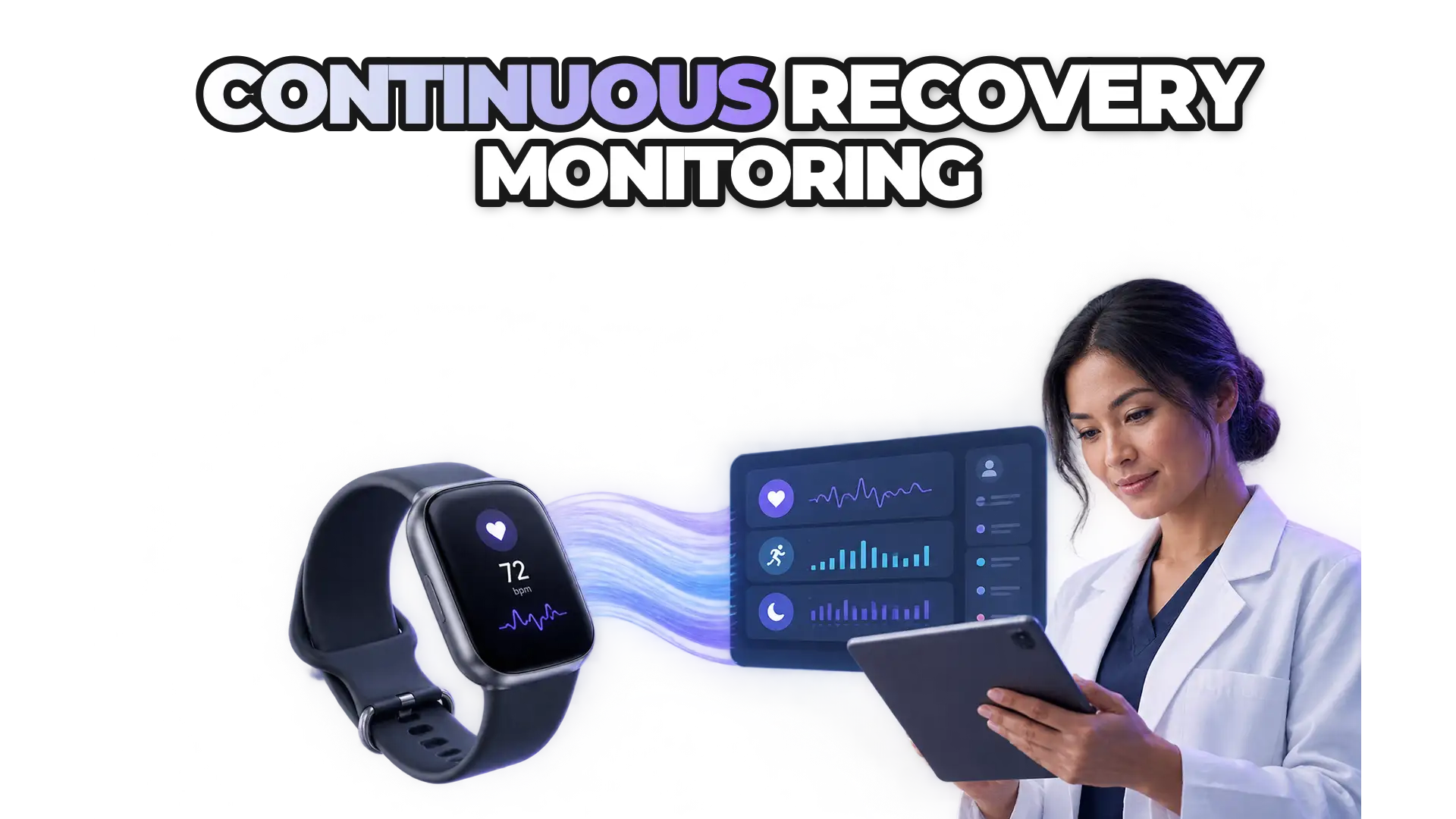
Wearables support post-surgical rehabilitation by tracking activity, sleep, heart rate, and other recovery trends between clinical visits, so care teams can compare a patient with their own baseline instead of relying on recall. The data is useful only once it is standardized across devices, interpreted in context, and reviewed inside a patient-monitoring workflow. ROOK Connect provides that standardized data layer, while clinicians keep every clinical decision.
Post-surgical rehabilitation is essential for restoring mobility, rebuilding strength, and reducing the risk of complications after a procedure. Yet much of the recovery process happens outside the clinic, where healthcare professionals have limited visibility into a patient’s daily activity, sleep, and adherence to rehabilitation plans.
Wearable devices can help close that visibility gap. Smartwatches, fitness trackers, rings, connected medical devices, and rehabilitation sensors can collect health and behavioral data throughout the recovery journey.
The challenge is turning fragmented measurements from different devices into consistent, usable information, not simply collecting more data.
This is where health data infrastructure becomes important. Through ROOK Connect, product and healthcare teams can integrate and standardize data from multiple wearable sources through one unified infrastructure.
What is wearable-based post-surgical rehabilitation?
Wearable-based post-surgical rehabilitation uses connected devices to monitor health, activity, and recovery patterns while a patient completes rehabilitation outside traditional clinical settings.
Depending on the device and use case, wearables may capture:
- Daily steps and general movement
- Active and sedentary time
- Heart rate and resting heart rate
- Sleep duration and sleep patterns
- Energy expenditure
- Workout or rehabilitation activity
- Oxygen saturation
- Temperature trends
- Range of motion or movement quality
Not every wearable provides every metric, and consumer devices should not automatically be treated as medical devices. Before designing a rehabilitation program, teams should review the health metrics and supported data sources available through ROOK.
How can wearables support post-surgical recovery?
Wearables can provide a more continuous view of post-surgical recovery than occasional appointments alone. Wearable data helps care teams understand what happens between visits and see changes a clinician may choose to review.
Wearable data should support, not replace, clinical evaluation and professional judgment.
What activity data should rehab teams track between visits?
Between clinical visits, wearable activity data can show whether a patient is gradually returning to movement or remaining more sedentary than expected.
For example, a rehabilitation program may monitor:
- Changes in daily step count
- Active minutes
- Time spent sedentary
- Exercise duration
- Recovery after physical activity
A single low-activity day may not be meaningful. A sustained decline relative to the patient’s own baseline, however, may provide useful context for the next clinical interaction.
For organizations exploring rehabilitation and other applications, ROOK provides examples of wearable health data use cases across healthcare and other industries.
How do wearables show rehabilitation progress over time?
Wearable data can show rehabilitation progress as trends, which matters because post-surgical recovery is rarely linear. Patients may improve steadily, experience plateaus, or show temporary declines due to pain, poor sleep, stress, medication changes, or reduced adherence.
Wearable trend data helps teams evaluate the direction of recovery instead of relying only on isolated measurements.
The most useful comparison is often between the patient’s current behavior and their own previous baseline, not between one patient and a general population average.
A standardized health indicator such as ROOK Score can also help applications summarize multiple dimensions of health data. Any score used in rehabilitation should be interpreted according to its intended purpose and should not be presented as a clinical diagnosis.
What can wearable sleep data show during recovery?
Wearable sleep data can give care teams visibility into sleep, which plays an important role in recovery but is difficult to assess through occasional patient conversations alone.
Compatible wearables may provide information about:
- Sleep duration
- Sleep timing
- Sleep interruptions
- Sleep stages
- Nighttime heart rate
- Recovery-related trends
Wearable sleep measurements do not diagnose sleep disorders, but they can add context to changes in activity, fatigue, or engagement with rehabilitation.
The relationship between continuous data and healthcare is also discussed in ROOK’s collection of conversations about wearables, healthcare, and health data.
How does wearable data support remote follow-up after surgery?
Wearable data can complement telehealth and remote patient monitoring by providing information collected between virtual or in-person consultations.
Instead of depending entirely on patient recall, a care team may review longitudinal patterns such as activity progression, sleep regularity, or changes in resting heart rate.
For patients who need a simpler way to connect their devices, the ROOK App can support device authorization without requiring every organization to build its own connection interface.
The application that uses ROOK remains responsible for deciding how data is presented, reviewed, and incorporated into the rehabilitation workflow. Related reading: why most remote monitoring setups don’t scale.
Which wearables can be used in post-surgical rehabilitation?
The right wearable for post-surgical rehabilitation depends on the surgical procedure, the rehabilitation objectives, and the level of clinical validation required.
What can smartwatches and activity trackers monitor after surgery?
Smartwatches and fitness trackers can support general monitoring of movement, steps, activity, sleep, and heart-rate trends.
Smartwatches and activity trackers may be relevant for recovery programs involving:
- Orthopedic procedures
- Cardiovascular surgery
- Mobility restoration
- General conditioning
- Return-to-activity planning
Smartwatches and activity trackers are especially useful for observing long-term patterns, but their measurements should always be evaluated according to the capabilities and limitations of each device.
When are smart rings useful after surgery?
Smart rings may be useful when sleep and general recovery trends are important. Smart rings can capture sleep, activity, resting heart rate, and other recovery-related signals in a compact form factor.
Patient comfort, adherence, and device-specific metrics should still be considered before choosing a smart ring.
Which connected medical devices can a rehab program add?
Depending on the patient and procedure, a rehabilitation program may also incorporate blood pressure monitors, pulse oximeters, glucose monitors, or other connected medical devices.
Connected medical devices can provide valuable context, but integrating wearable and medical-device data requires attention to units, timestamps, provenance, and intended use.
What do rehabilitation and motion sensors measure?
Specialized rehabilitation and motion sensors can measure movement quality, joint angles, exercise execution, or range of motion. Motion sensors may provide more targeted information than a general-purpose smartwatch.
The value of a motion sensor depends on whether its measurements have been validated for the specific procedure, population, and rehabilitation objective.
Why does wearable data need to be standardized?
Wearable data needs standardization because connecting a device does not automatically make its data usable.
Different wearable providers may use different:
- Data schemas
- Metric definitions
- Units of measurement
- Sampling frequencies
- Timestamp conventions
- Synchronization methods
- Proprietary algorithms
Two devices may report the same metric while calculating it differently. If these differences are ignored, healthcare teams may compare values that are not truly equivalent.
ROOK helps address this infrastructure problem by giving applications normalized wearable data through one consistent integration layer. A single layer can reduce the need to build and maintain a separate pipeline for every provider. For a device-by-device example, see how to standardize wearable data from Fitbit, Apple Watch, and Garmin.
To understand the broader integration challenge, explore ROOK’s discussions on turning wearable data into usable health solutions and its earlier collection of wearable technology and health data conversations.
What should a post-surgical monitoring system do?
A reliable post-surgical monitoring system should do more than display raw wearable data.
A wearable-based rehabilitation system should:
- Establish a personal baseline when clinically appropriate.
- Compare changes across days and weeks.
- Preserve the source and timestamp of every measurement.
- Distinguish missing data from genuine inactivity.
- Combine activity, sleep, and physiological context.
- Present information in a way clinicians can review efficiently.
- Escalate only the changes defined by the care team.
- Keep a human professional responsible for clinical decisions.
ROOK provides the standardized data layer, while the healthcare application defines the monitoring logic, thresholds, clinical workflows, and interventions. ROOK moves and standardizes the data; it does not diagnose or replace clinical judgment.
What are the challenges of wearable-based rehab monitoring?
The main challenges of wearable-based rehabilitation monitoring are data accuracy and clinical validation, patient privacy and consent, alert fatigue, and patient adherence.
How accurate is wearable data for clinical use?
Not all wearable metrics are equally accurate or suitable for clinical use. Performance can vary by device, population, activity, placement, and measurement conditions.
Organizations should verify:
- Whether the device is appropriate for the intended use
- Whether the relevant metric has been independently validated
- How the manufacturer calculates derived measurements
- Whether the data is being used for wellness, monitoring, research, or diagnosis
- What level of evidence the use case requires
ROOK can standardize data from connected sources, but standardization does not transform a consumer measurement into a clinically validated endpoint. For the limits of consumer devices, see what smartwatch health data doesn’t tell you.
Why do privacy and consent matter in wearable rehab monitoring?
Wearable data may reveal sensitive details about a patient’s health, behavior, location, and daily routine.
A responsible implementation should define:
- What information will be collected
- Why it is needed
- Who can access it
- How long it will be retained
- How consent and revocation will work
- Which privacy and security requirements apply
Privacy obligations depend on the organization, jurisdiction, workflow, and relationship between the parties. Integration infrastructure should be evaluated as part of the organization’s broader compliance program.
How can wearable rehab monitoring avoid alert fatigue?
More data can create more noise. Wearable rehab monitoring can avoid alert fatigue by surfacing meaningful changes instead of alerting on every deviation. If every deviation generates an alert, clinicians may receive too many notifications to identify meaningful changes.
Effective monitoring should prioritize:
- Personalized baselines
- Sustained changes instead of isolated readings
- Multiple signals evaluated together
- Clinical context
- Clearly defined escalation protocols
The objective of rehab monitoring is not to generate the greatest number of alerts. It is to surface information that is relevant enough to support a timely decision.
Why does patient adherence matter for wearable rehab monitoring?
Wearable monitoring works only when patients consistently wear, charge, synchronize, and authorize their devices.
Applications should account for:
- Missing data
- Device removal
- Battery depletion
- Synchronization failures
- Permission changes
- Differences in digital literacy
A missing reading should never automatically be interpreted as a deterioration in the patient’s condition.
How does ROOK support wearable-based rehabilitation products?
ROOK provides health data infrastructure that helps digital health teams connect and standardize information from multiple wearable sources.
With ROOK, product teams can:
- Reduce device-by-device integration work
- Access normalized health and activity data
- Preserve the origin of connected measurements
- Build applications around a more consistent schema
- Deliver data into their own monitoring and analytics workflows
- Expand device compatibility without rebuilding the entire data layer
ROOK’s infrastructure can support digital health platforms, remote monitoring products, rehabilitation applications, wellness programs, and research workflows.
Developers can begin with the ROOK Connect technical documentation and review the complete list of available wearable data sources.
Post-surgical rehabilitation wearables: frequently asked questions
Can wearables improve post-surgical rehabilitation?
Wearables can support post-surgical rehabilitation by tracking activity, sleep, heart rate, and other recovery-related trends between clinical visits. Their effectiveness depends on device accuracy, patient adherence, data quality, and integration with a professionally designed care plan.
Which wearable metrics are useful after surgery?
Relevant metrics may include steps, active time, sedentary time, sleep duration, resting heart rate, exercise sessions, and—in compatible devices—oxygen saturation or temperature trends. The appropriate metrics depend on the procedure and clinical objective.
Can wearable data detect post-surgical complications?
Wearable data may reveal changes that warrant further assessment, but it should not independently diagnose a complication. Clinical evaluation and approved diagnostic methods remain necessary.
Does ROOK provide clinical alerts?
ROOK provides standardized health data infrastructure. Applications and healthcare organizations use that data to create their own monitoring rules, dashboards, notifications, and clinical workflows.
Can ROOK connect data from different wearable brands?
Yes. ROOK is designed to help applications connect and standardize data from multiple supported sources through one consistent infrastructure. Developers should consult the current ROOK data-source documentation for compatibility details.
Can wearable data replace in-person rehabilitation?
No. Wearable data can complement rehabilitation by improving visibility between appointments, but it does not replace physical examinations, clinical judgment, or direct treatment from qualified professionals.
What does wearable data need to support rehabilitation?
For wearable data to support post-surgical rehabilitation, it must be reliable, standardized, contextualized, and incorporated into an appropriate clinical workflow. A fragmented collection of device metrics cannot provide that foundation on its own.
With that foundation, wearables make recovery more visible between clinical visits and help teams follow movement, sleep, activity, and physiological trends throughout the patient journey.
ROOK helps product teams solve the integration and standardization layer so they can focus on building rehabilitation experiences, remote monitoring workflows, and patient-facing applications.
 Written byJuana Carolina Ordoñez MerchanInternal Digital Marketing